US adds 29,000 nonfarm jobs in September; unemployment rate at 4.2%
The US added 29,000 nonfarm jobs in September, while the previous two months were revised down by a combined 60,000. Industry patterns, long-term unemployment, wages and hours reveal more about employment conditions than a single headline figure.
By Global Bole News
Research and compilation
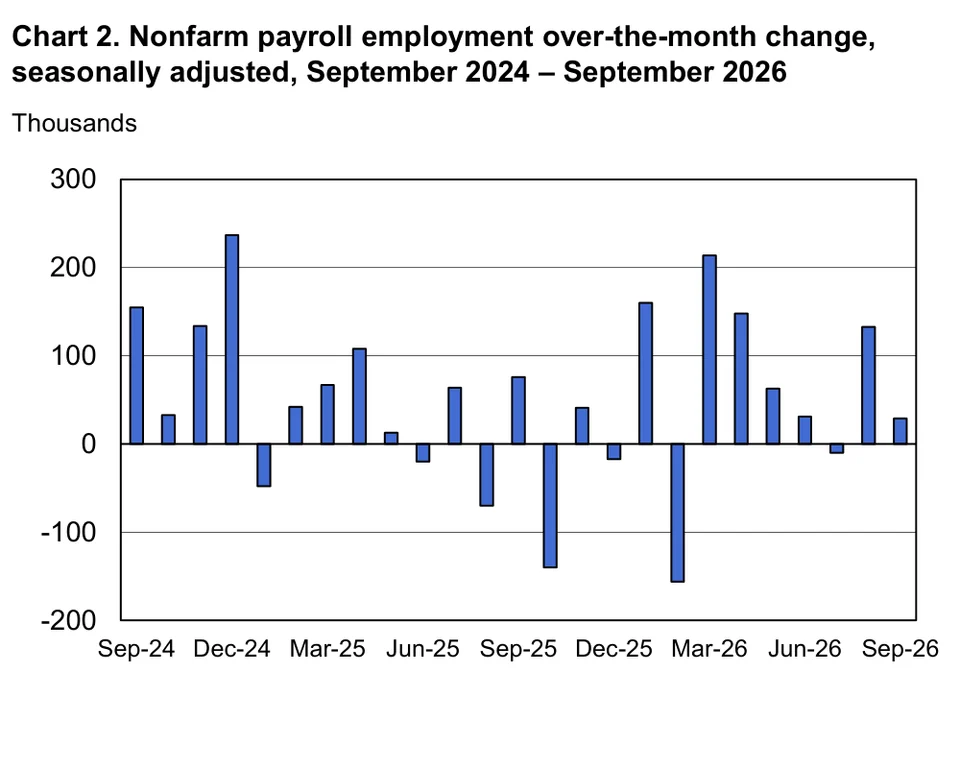
US nonfarm employment rose by 29,000 in September, and the unemployment rate was 4.2%. The Bureau of Labor Statistics (BLS) report released on October 2 also revised the combined job gains for July and August downward by 60,000. Taken together, the month's increase and the revisions still point to a labor market with weak hiring growth and divergent performance across industries.1
Over the preceding 12 months, nonfarm employment had risen by an average of 45,000 jobs per month. September's increase was below that pace, but the BLS described the monthly changes in both nonfarm employment and the unemployment rate as having “changed little.” That wording reminds readers that monthly fluctuations need to be understood in the context of longer-term trends and statistical uncertainty.
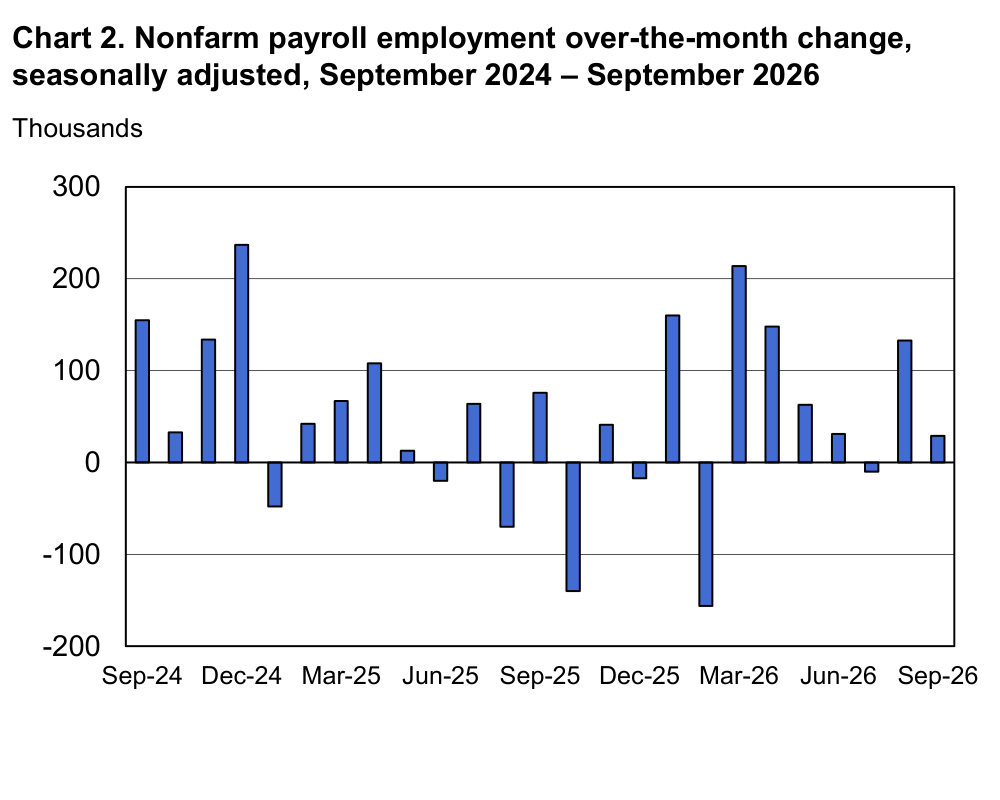
Figure: Original US Bureau of Labor Statistics chart showing seasonally adjusted monthly changes in nonfarm employment from September 2024 to September 2026, in thousands. Source and chart: US Bureau of Labor Statistics, original charts from the September 2026 employment report, public-domain work.1
Health care continues to add jobs as finance adjusts
Health care added 17,000 jobs in September, below its average monthly increase of 33,000 over the previous 12 months. Within the sector, ambulatory health care services and hospitals added 13,000 and 12,000 jobs, respectively, while nursing and residential care facilities lost 9,000. Construction added 11,000 jobs and manufacturing added 9,000. The BLS also noted that employment changed little overall across the major industries that month; these increases and decreases are not yet sufficient to establish a turning point in each industry.1
Employment in financial activities fell by 7,000. Over a longer period, the sector has lost 129,000 jobs since its recent peak in May 2025, including 90,000 in insurance and related activities. A small increase in the national total does not mean job-search conditions are improving in every industry.
Beyond the unemployment rate, look at hours and the length of job searches
About 7.1 million people were unemployed in September. Roughly 1.9 million had been unemployed for 27 weeks or longer, representing 27.1% of all unemployed people. About 4.5 million were working part time involuntarily because their hours had been reduced or they could not find full-time jobs. Both groups changed little in size that month, but they reflect circumstances the unemployment rate alone cannot capture: finding a job, securing enough hours and ending a lengthy job search remain distinct challenges.1
The labor force participation rate was 61.8%, and the employment-population ratio was 59.2%. The measurement basis also matters: nonfarm payroll figures come from an employer survey, while the unemployment rate and related indicators come from a household survey. Their coverage differs, so job gains cannot be directly netted against changes in the number of unemployed people.
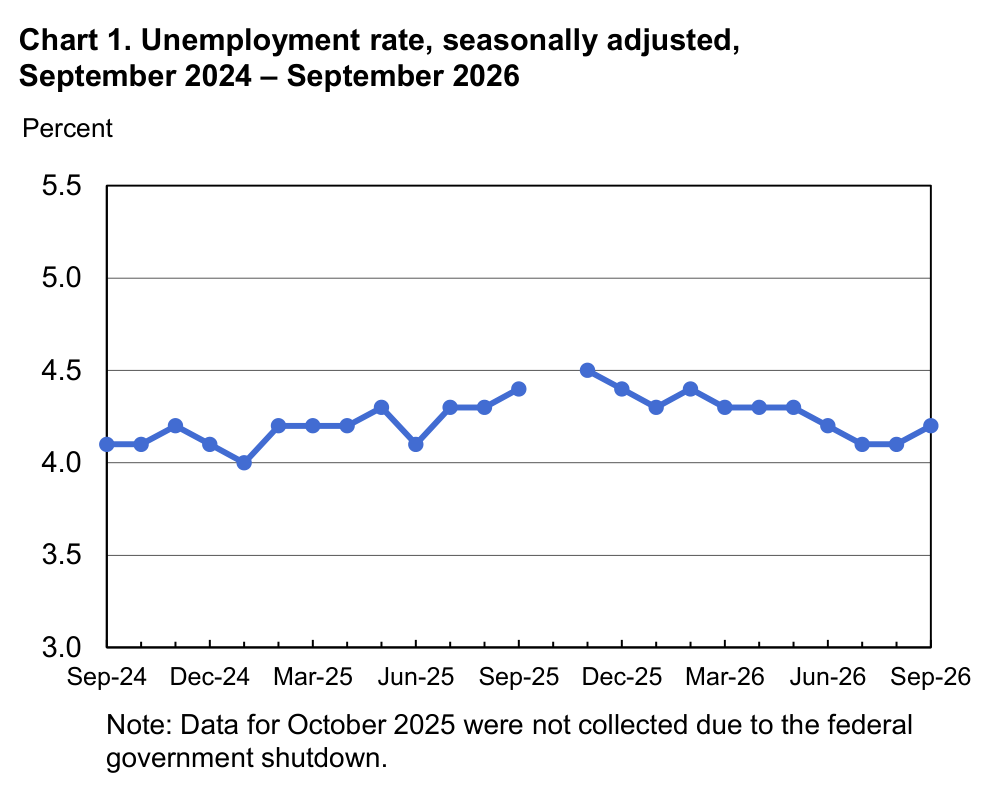
Figure: Original US Bureau of Labor Statistics chart showing the seasonally adjusted unemployment rate from September 2024 to September 2026. The original chart retains the note that data were not collected in October 2025 because of the federal government shutdown. Source and chart: US Bureau of Labor Statistics, original charts from the September 2026 employment report, public-domain work.1
How does the 60,000-job downward revision change the recent picture?
The employment change for July was revised from a gain of 21,000 to a loss of 10,000, and August's increase was revised from 162,000 to 133,000, for a combined downward revision of 60,000. Additional survey responses and recalculated seasonal factors both contribute to monthly revisions; September's figures are also still preliminary estimates.1
On wages, average hourly earnings for private nonfarm employees were $37.81, up 0.1% from the previous month and 3.0% from a year earlier. The average workweek remained at 34.4 hours. Wages and hours did not both decline sharply, but hourly earnings here are a nominal measure; assessing purchasing power also requires comparison with price changes.
The evidence points more to slow growth than a sudden downturn
Average monthly job gains over the past year were already modest, and September's unemployment rate remained within the narrow 4.1%–4.3% range seen since March. That makes “limited employment growth” a closer description of the evidence than “a sudden deterioration in the labor market.” At the same time, the downward revisions to the previous two months make recent hiring look less strong than first reported.
Sampling uncertainty further limits what can be inferred from a single month's figures. At the 90% confidence level usually used by the BLS, a monthly change in nonfarm employment of about 122,000 is needed to meet the threshold for statistical significance. A gain of 29,000 can help in tracking trends, but is not well suited to supporting strong conclusions about recession or interest rates on its own.2
The next employment report is expected on November 6. Alongside the new job figures, it will be worth watching whether the revised September figures, long-term unemployment, labor force participation and working hours change together. Whether those indicators corroborate one another will be more persuasive than one striking monthly increase.
Source notes
-
October 2, 2026, US Bureau of Labor Statistics, The Employment Situation — September 2026. ↩ ↩2 ↩3 ↩4 ↩5 ↩6
-
Updated April 20, 2026, US Bureau of Labor Statistics, CES Frequently Asked Questions; the explanation of statistical significance also appears in the technical notes to the source in footnote 1. ↩