Zelensky says Ukraine will step up strikes on Russian refineries as attacks on Kyiv bridges highlight infrastructure risks
Zelensky says Ukraine will intensify strikes on Russian refineries, while Kyiv bridges face repeated attacks. Public statements, actual damage and civilian effects require separate verification; changes in capacity or oil prices cannot yet be directly inferred.
By Global Bole News
Research and compilation
Ukrainian President Volodymyr Zelensky told Reuters in an interview on October 3 that Ukraine would intensify strikes on Russian oil-refining facilities in response to what he described as an expansion of Russian air attacks on Ukrainian cities. He also stressed that Ukraine would not attack civilian targets indiscriminately. He said Ukrainian intelligence services had obtained documents on Russia's new approach to attacks; neither the document nor its contents had been independently verified in public reporting.1
Bridge damage affects how the city functions
The remarks came amid repeated attacks on Kyiv's transport infrastructure. The Kyiv Independent reported that Russian forces struck the Northern Bridge across the Dnipro River early on October 3. Mayor Vitali Klitschko said the road surface and trolleybus overhead wires were damaged, two people were injured and traffic was temporarily halted. The Southern Bridge had also faced successive drone attacks. At the time of publication, the full extent of damage to the Northern Bridge remained unclear; disruption to traffic should not be equated with destruction of the bridge itself.2
The effect of attacks on bridges depends on more than the extent of structural damage. Kyiv's two banks rely on river crossings for commuting and transport. Even if a bridge remains standing, temporary closures and traffic restrictions during alerts affect the city's functioning. Aviation experts interviewed by the newspaper said the attacks may have been intended to obstruct movement, disrupt logistics and create psychological pressure. This is expert analysis of possible intent, not a confirmed statement of Russian operational objectives.2
Statements about a response do not establish verified damage
Zelensky linked the planned intensification of refinery strikes to Russia's sources of war funding. Reuters reported that the Kremlin could not provide comment that day, while Russia's Foreign Ministry said in a statement urging foreigners to leave Kyiv that it would continue what it described as retaliatory strikes. Both Russia and Ukraine deny deliberately targeting civilians.1 Claims of a “new doctrine,” “retaliation” and the reasons for target selection therefore need to remain clearly attributed to their respective speakers.
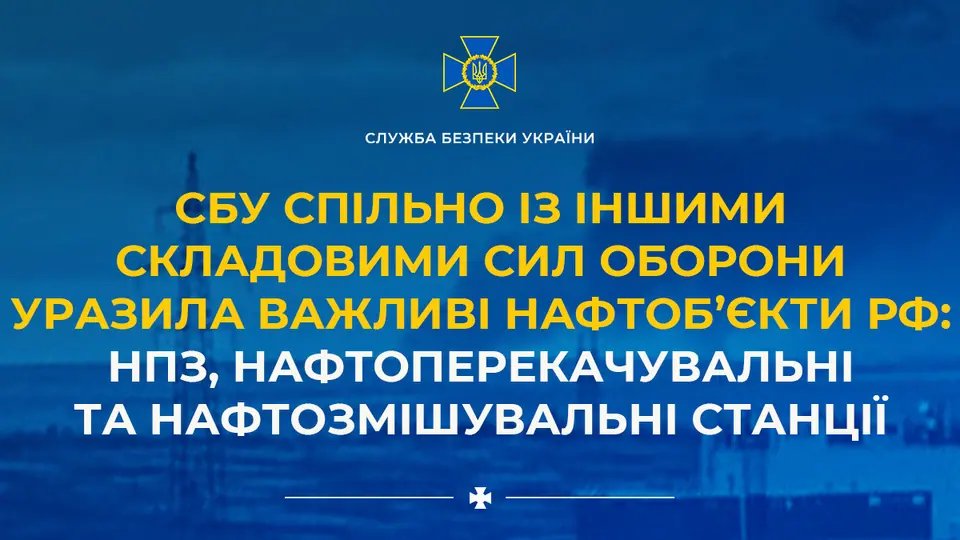
Ukrainian attacks on Russian oil facilities are not limited to this new statement. In an announcement on October 2, the Security Service of Ukraine said it had joined other forces in striking four oil infrastructure sites in the Samara and Volgograd regions, including pumping stations and the Volgograd refinery, and reported fires at the sites.3 The announcement establishes that Ukraine publicly claimed to have conducted these operations, but cannot by itself establish the actual damage to every facility, the duration of shutdowns or production losses.

Figure: Illustration accompanying the Security Service of Ukraine's October 2, 2026 announcement that it had joined other forces in striking Russian oil facilities. The text in the image is a Ukrainian statement; this is not a photograph of damage at the sites. Source and license: Security Service of Ukraine (SBU), original announcement, CC BY 4.0.3
The civilian effects of attacks on energy facilities cannot be overlooked
Attacks on energy facilities also raise legal and humanitarian questions that political statements cannot resolve. An analysis by legal advisers at the International Committee of the Red Cross notes that whether energy infrastructure constitutes a military objective must be assessed in the specific circumstances. Even when a facility has a military use, attacks must still comply with the principle of proportionality and the obligation to take precautions. Reasonably foreseeable indirect harm from power cuts to services such as drinking water, health care and sanitation must also be included in the assessment.4
A declaration that civilians will not be attacked therefore does not automatically establish that a particular strike will cause no civilian harm; responding on the grounds of having been attacked does not remove the relevant obligations either. Assessing the current escalation thus requires considering targets, actual damage and the capacity to recover together. Images of fires alone cannot determine military effectiveness, and labeling a facility “strategic” does not remove the need to examine its civilian functions.
Two connected developments will be central to what happens next: whether Kyiv's bridges and other public facilities can return to reliable operation, and how much lasting impact the attacks have had on oil facilities inside Russia. Without verified shutdown, repair and market data, the statement cannot yet be used to calculate changes in diesel or global oil prices. What can be confirmed is that attacks, defenses and public threats centered on infrastructure continue, while the risks borne by urban residents and energy systems require ongoing attention.
Source notes
-
Reuters, Daniel Flynn and Olena Harmash, republished by MarketScreener, Ukraine will hit Russian refineries in response to Moscow's 'new doctrine' of airstrikes, Zelenskiy says, October 3, 2026, published at 12:02 EDT and updated at 16:25 EDT. ↩ ↩2
-
The Kyiv Independent, Dmytro Basmat and Jonas Heins, Russia strikes second Kyiv bridge during 3rd straight day of infrastructure attacks, October 3, 2026, 07:53. ↩ ↩2
-
Security Service of Ukraine (SBU), СБУ спільно із іншими складовими Сил оборони уразила важливі нафтоб’єкти рф: НПЗ, нафтоперекачувальні та нафтозмішувальні станції (the Ukrainian security service says it joined other defense forces in striking Russian refineries and oil pumping and blending facilities), October 2, 2026, 11:45. ↩ ↩2
-
International Committee of the Red Cross, Humanitarian Law & Policy blog, Eirini Giorgou and Abby Zeith, When the lights go out: the protection of energy infrastructure in armed conflict, April 20, 2023. ↩