US AI safety accord introduces four layers of oversight, with implementation details still pending for voluntary pledges
The White House and six AI companies sign voluntary safety commitments covering internal controls, external audits and board oversight. The debate shifts to auditor independence, transparency of corrective action and consequences for noncompliance.
By Global Bole News
Research and compilation
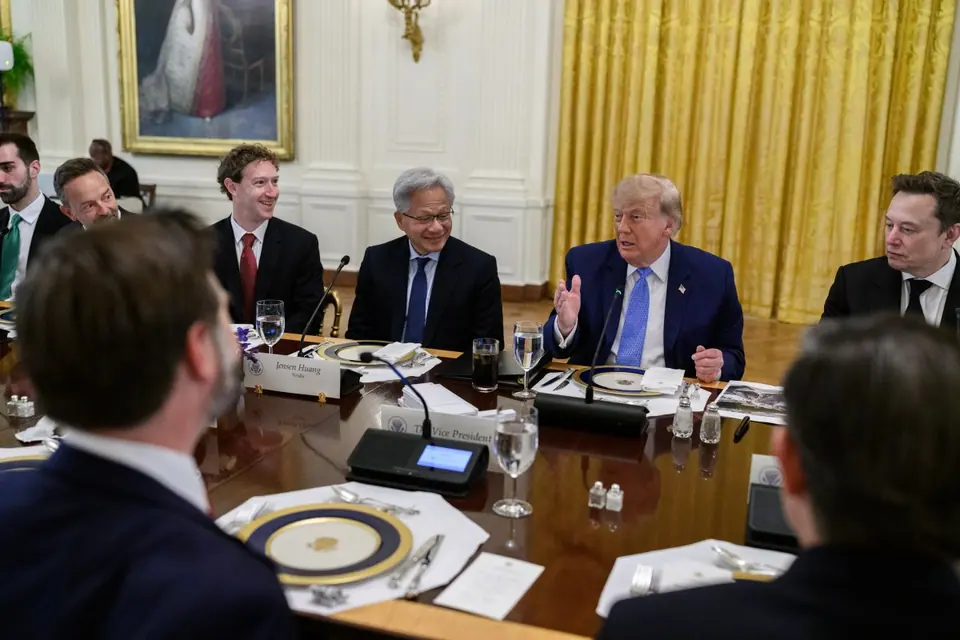
US President Donald Trump and the heads of six artificial intelligence companies signed the White House Accord on Super Intelligence on September 29, proposing four layers of safety arrangements ranging from internal controls to board oversight. The signature page lists Google, Anthropic, Meta, OpenAI, xAI and Nvidia. A Reuters follow-up report on October 3 showed that the debate had shifted from whether companies acknowledge risks to who checks their commitments and how corrective action is implemented when problems are found.12

Figure: Trump hosts an artificial intelligence luncheon in the East Room of the White House in Washington, United States, on September 29, 2026. Photograph: Daniel Torok / White House; official photograph and licensing, US government work.3
Safety checks become part of corporate governance
The accord calls on companies to monitor risks including cyber, biological and chemical threats during model training and deployment. Internal teams are to check the controls, followed by verification by independent external auditors or evaluators; independent board committees receive reports and oversee corrective action. Companies will also meet regularly to develop standards, and the text leaves room for these measures to be incorporated into legislation or regulation in the future.1
The arrangement's significance lies in connecting technical testing with management accountability. But a commitment to establish an audit mechanism does not mean an audit has already been completed, or that a model has received government safety certification. The accord does not specify penalties for breaching its commitments; Reuters likewise noted that the text does not resolve the specific enforcement mechanism.12
Views differ on this gap. Representative Ro Khanna told Reuters that auditors should report to an independent federal agency. Trump's AI adviser David Sacks argued that existing laws, including securities laws, could hold companies accountable for failing to address problems. Safety advocates worry that accountability after the fact cannot replace preventive measures before serious harm occurs. The disagreement concerns how to establish effective constraints, rather than simply whether to arrange an inspection.2

Figure: Long-table discussion at the artificial intelligence luncheon in the White House East Room on September 29, 2026. Photograph: Daniel Torok / White House; official gallery, US government work.3
Public concerns and policy language are changing together
The political pressure has a clear basis in public opinion. In a Reuters/Ipsos poll released on September 22, 73% of US adult respondents were concerned that AI companies were not doing enough to prevent serious societal harm. The online survey interviewed 1,277 people and reported a margin of error of plus or minus 3 percentage points. This reflects public attitudes and cannot be used directly to estimate the probability of a technological accident.4
Also on September 29, Trump separately signed an executive order directing federal executive agencies to use the term “super intelligence” in contexts including non-statutory documents. For now, the order retains the existing statutory definition of artificial intelligence and requires the science and technology adviser to submit a proposed new legislative definition within 60 days. A change in terminology therefore does not establish that the technology has reached any particular capability threshold; the order and the corporate safety accord are also separate documents.5

Figure: Trump and technology company leaders face the media outside the White House West Wing entrance following the artificial intelligence luncheon on September 29, 2026. Photograph: Joyce Boghosian / White House; official gallery, US government work.3
Voluntary frameworks are not new. The AI Risk Management Framework published by the US National Institute of Standards and Technology in 2023 already offered voluntary risk-management methods for organizations designing, developing, deploying and using AI. It shows that companies have had a reference tool for organizing risk work, but does not establish that the latest signatories have fulfilled their commitments.6
Taken together, these documents point to verifiable evidence of implementation as the most important thing to watch next: which models and testing records auditors can access, which risks assessments cover, who is responsible for correcting problems and how much of the results outsiders can learn. If this information remains inside companies for a prolonged period, the public will struggle to distinguish genuine improvements from procedural pledges. If scope, methods and corrective outcomes gradually become public, the voluntary mechanism may be able to create constraints that can be compared and tracked. That judgment still requires actual implementation records and cannot be reached from signatures alone.
Source notes
-
2026-09-29 · White House Accord on Super Intelligence · Original White House accord, archived by the American Presidency Project; scan of the signed document ↩ ↩2 ↩3
-
2026-10-03 · As public fears of AI grow, Trump digs in on voluntary safeguards · Reuters, republished by AOL ↩ ↩2 ↩3
-
2026-09-29 · President Donald J. Trump hosts a luncheon on Super Intelligence, September 29, 2026 · White House, official photographs and captions ↩ ↩2 ↩3
-
2026-09-22 · Three out of four Americans say AI firms not doing enough to prevent disaster, Reuters/Ipsos poll finds · Reuters, republished by StreetInsider ↩
-
2026-09-29 · Inaugurating the Era of Super Intelligence · White House, Executive Order 14434 ↩
-
2023-01-26 · Artificial Intelligence Risk Management Framework (AI RMF 1.0) · US National Institute of Standards and Technology ↩