G7 announces release of 100 million barrels of oil reserves over four months, front-loading diesel in the first 20 days
With 100 million barrels over four months, front-loaded diesel releases in the first 20 days and coordinated refinery maintenance, the G7 is focusing on fuel delivery. The total pledge is not an immediate increase in supply.
By Global Bole News
Research and compilation
The G7 is preparing to release 100 million barrels of oil reserves over four months, with a substantial diesel release scheduled for the first 20 days. A leaders' statement released by the French presidency on October 2 said the action, coordinated by the International Energy Agency (IEA), would begin immediately, but did not specify the number of barrels of diesel to be released in the initial period.1
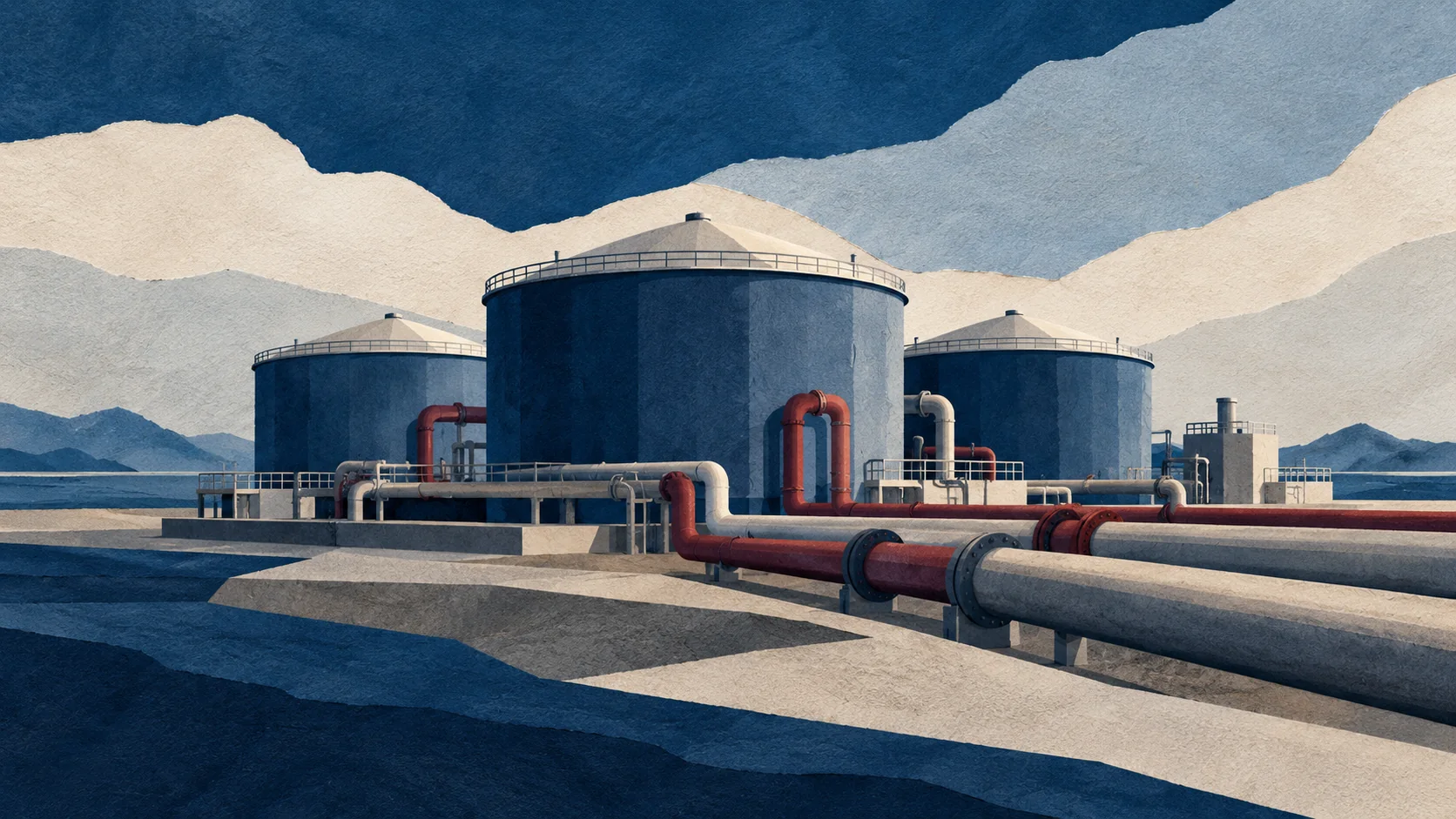
Figure: AI-generated conceptual illustration: oil storage facilities and a fuel supply network.
Two aspects of the arrangement should be considered together: it increases the stocks available for release while also adjusting refinery production schedules. How much pressure it ultimately relieves will depend on the form in which fuel arrives, when it arrives and where it goes.
Front-loading diesel targets deliveries of refined products
The statement uses the phrase “frontloaded substantial diesel release,” emphasizing a substantial release of diesel early in the process. Supporting measures include coordinating G7 refinery maintenance to avoid simultaneous shutdowns and temporarily raising utilization rates where feasible. The parties also encourage cooperation with countries that have substantial refining capacity to increase supplies of refined products.1
Crude oil reserves and diesel ready for delivery and use occupy different positions in the supply chain. In the United States, for example, most diesel is refined from crude oil, and it is widely used in freight transport, agriculture and construction equipment.2 For businesses that rely on these activities, the volume of crude oil in storage and the ability to secure enough fuel in the near term are closely related but distinct questions.
Bringing diesel releases forward and minimizing simultaneous refinery shutdowns can be understood as addressing immediate deliveries and subsequent production, respectively. This is why focusing only on the “100 million barrels” total risks overlooking the key steps that determine whether the policy will work.
The 100 million barrels cannot simply be added to earlier pledges
On March 11, the IEA announced that its 32 member countries had agreed to make 400 million barrels of emergency stocks available to the market, with release schedules determined by each country's circumstances. That was a commitment made in March, not a figure that can automatically be treated as completed deliveries by October.3
The latest G7 statement calls for tracking implementation of the March commitments while explicitly taking account of the portion already fulfilled.1 Simply adding the earlier 400 million barrels to the latest 100 million to arrive at 500 million barrels of additional supply would therefore confuse commitments with execution. Treating the entire 100 million barrels as diesel would likewise go beyond the statement.
Determining how much extra supply has actually reached the market requires country-by-country release schedules, the composition of the products and the relationship between this arrangement and earlier commitments. Until those details are fully disclosed, the total is more useful for understanding the scale of the action than for calculating an immediate increase in supply.
Reserves buy time, but the effect still depends on implementation
Releasing inventories can provide a buffer, but its size depends on the speed and location of deliveries. If fuel cannot reach the places that need it in time, even a large pledge will do little to ease local shortages immediately. Even when releases proceed smoothly, reserves are depleted, and replenishment must also be arranged.
The G7 has asked the IEA to submit a report on implementation and impact within 20 days, together with recommendations including replenishment.1 This will be an important checkpoint: whether commitments have been delivered on time, whether releases have focused on the products and regions most in need, and whether refinery coordination has improved supply.
Every stage, from releasing stocks and refinery processing to cross-border transport and final distribution, can affect arrival times. The impact at the retail level may take even longer to be felt. At this stage, it is therefore more useful to track actual diesel release volumes, delivery schedules, refinery utilization and inventory changes than to conclude from the statement alone that oil prices have peaked.
This round of action sets out a relatively clear direction for short-term coordination. The real question ahead is whether policy commitments on supply can be turned into fuel that businesses and households can actually buy.
Source notes
-
October 2, 2026, French Presidency, G7 Leaders’ Statement on global energy security and market stability. ↩ ↩2 ↩3 ↩4
-
No publication date shown; accessed October 3, 2026, US Energy Information Administration, Diesel fuel explained: Use of diesel. ↩
-
March 11, 2026, International Energy Agency, IEA Member countries to carry out largest ever oil stock release amid market disruptions from Middle East conflict. ↩