South Korea’s K-GX plan: the fiscal, financial and industrial tasks behind 1,000 trillion won
South Korea unveiled its 2026–2035 K-GX strategy on October 7. Fiscal and climate-finance support is separate from 220 trillion won of corporate projects; capacity, vehicle and technology targets remain to be delivered.
By Global Bole News
Research and compilation
South Korea unveiled its Korea-Green Transformation (K-GX) strategy on October 7, bringing energy transition, industrial decarbonisation and green manufacturing into one policy framework for 2026–2035. The government proposed approximately 1,000 trillion won in fiscal and climate-finance support over ten years, equivalent to about US$747 billion at the exchange rate used by Reuters in its report. This is a multi-year policy scale, not money already disbursed or an amount entirely funded through direct budget spending.12
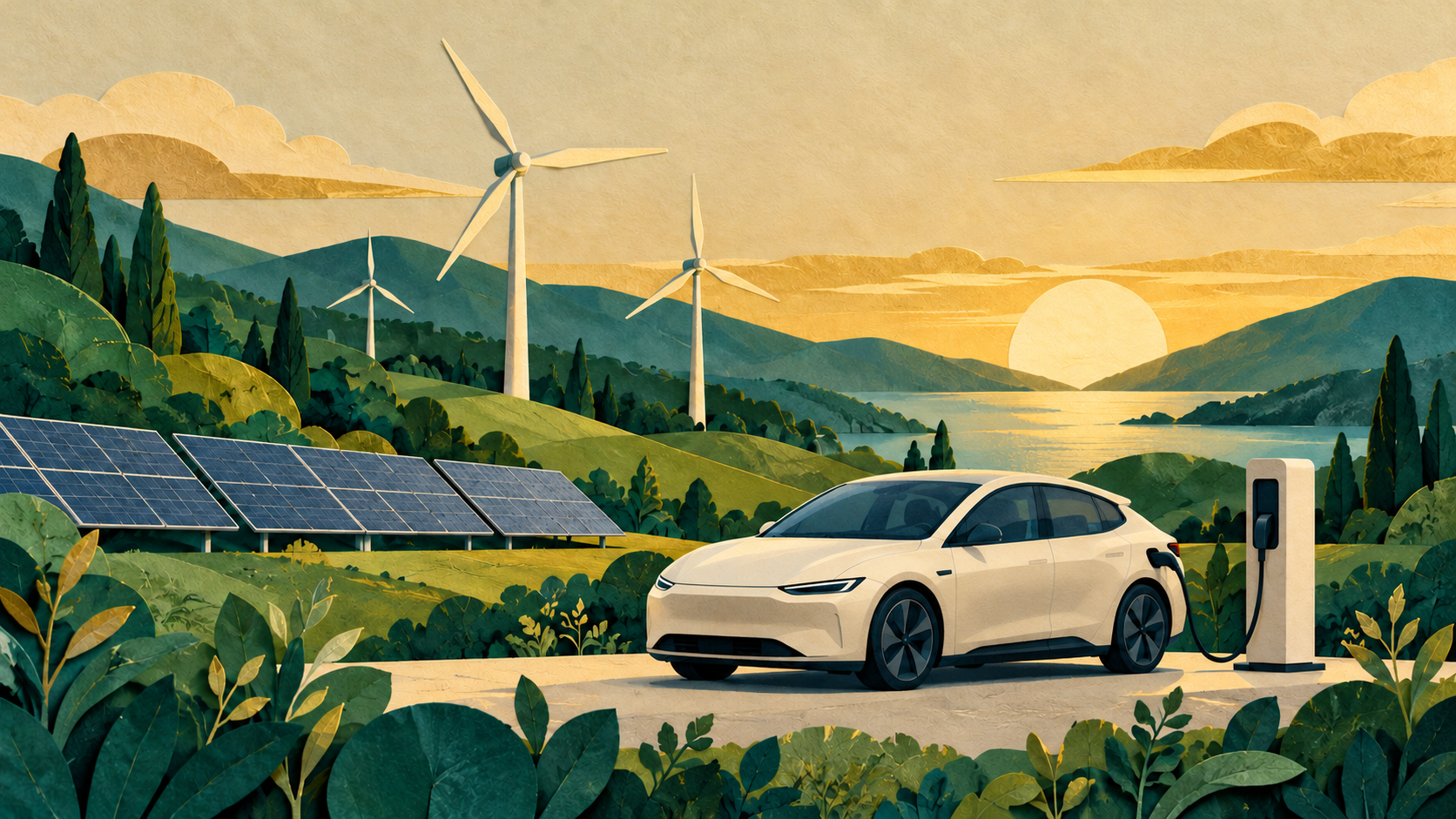
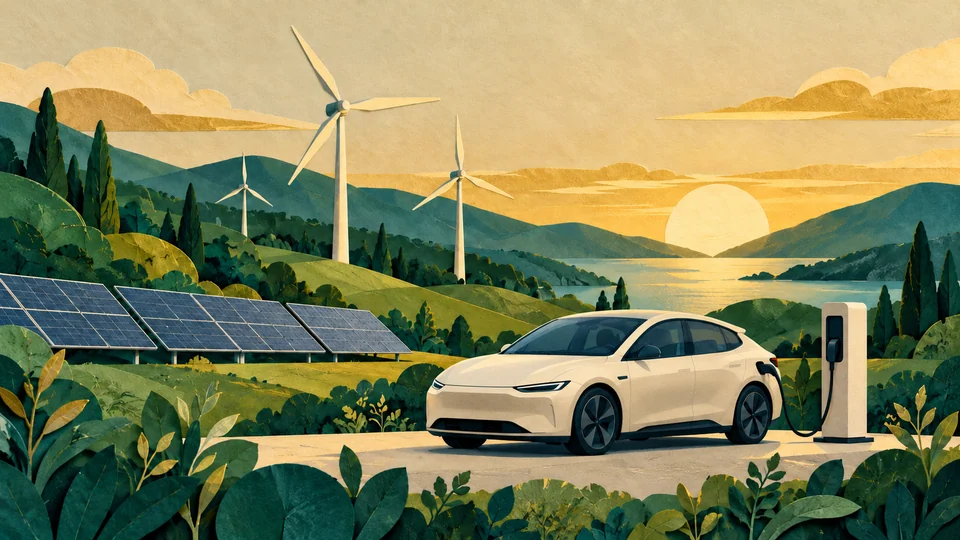
AI-generated illustration: wind turbines, solar panels and a vehicle-charging scene represent the energy transition; this is not a real South Korean location, vehicle model or completed project.
Three different kinds of financial numbers
The announced package comprises 200 trillion won in fiscal support, more than 790 trillion won in climate finance and other resources, described together as approximately 1,000 trillion won.1 Business-led signature projects of around 220 trillion won are listed separately.3
These numbers answer different questions. The fiscal figure concerns budget support, the financial figure concerns the provision of financing, and the corporate-project figure concerns investment plans. Policy finance can support corporate investment, connecting the financing side with the project side. Without project-level funding reconciliation and an explanation of overlaps, adding them into a single total of wholly new, independent expenditure would be inappropriate.
The ten-year framework sets a direction. Delivery still depends on annual budgets, financial-product terms, project approvals and actual corporate decisions. Equipment suppliers must distinguish a macro-level envelope from confirmed orders, with project financing and procurement in between. For borrowers, access to finance does not remove repayment obligations.
100 GW is total capacity; the vehicle target concerns new registrations
The government targets 100 gigawatts of total renewable capacity in 2030, alongside higher-capacity transmission lines and direct-current transmission and distribution. The 100 GW is cumulative capacity in the target year, not an additional 100 GW. Capacity also differs from actual electricity generation.1
The transport target is for battery-electric and hydrogen fuel-cell vehicles to account for at least 70% of newly registered vehicles by 2035. Yonhap’s report on the climate ministry’s announcement explicitly uses new registrations as the denominator. That does not mean 70% of all vehicles on the road will have been electrified by then, and conventional hybrids should not automatically be included.14
Together, the targets reveal the policies’ interdependence. Vehicles and industrial equipment using more electricity require corresponding generation and grid capacity; more solar and wind capacity requires transmission and balancing resources to reach consumers. Construction, successful connection and reliable utilisation are successive but distinct steps. A single capacity figure cannot measure the transition of the entire system.
Retrofitting established industries while developing new ones
K-GX addresses five groups of emissions-intensive industries: steel, petrochemicals, refining, cement, and semiconductors and displays. Its separate list of ten green industries covers electric vehicles, batteries, solar, wind, small modular reactors, power equipment, power semiconductors, heat pumps, hydrogen, and carbon capture, utilisation and storage. Low-carbon steel belongs to the transformation of established industry; the two lists should not be conflated.1
The policy concerns more than replacing energy sources. It also addresses moving technologies from demonstration to commercial operation. Companies must resolve not just whether equipment works, but process costs, product quality, reliable energy supply and customers’ willingness to buy. Including those conditions in investment assessment is more useful than judging prospective beneficiaries solely by their sector labels.
Connecting finance to emissions outcomes
The policy announcement directs climate finance towards regions and towards small, medium-sized and mid-sized businesses, with allocation priorities of at least 50% and at least 70%, respectively. Transition finance is intended to support decarbonisation in high-emission industries. The recipient categories can overlap, so their percentages cannot be added.1
These arrangements shift attention from the headline amount to implementation quality. Important questions are how support criteria will be defined, which projects actually secure financing and how emissions reductions are verified. Greater financing capacity can lower funding barriers for some projects, but does not replace mature technology, executable contracts or sustained market demand.
K-GX matters because it places industry, electricity, transport and finance within a long-term framework. Its effects must still materialise project by project: clear uses of funding, connected and operating electricity infrastructure, and industrial changes that produce verifiable emissions reductions. Approximately 1,000 trillion won is the policy starting point for that process, not evidence that the transition has already happened.
Source notes
-
2026-10-07 · KRW 1,000 trillion for Korea’s green transformation: from carbon reduction to a new growth engine · Korea Policy Briefing, joint government announcement; text is available under Korea Open Government License Type 1, with attribution. This text licence does not cover the photographs. ↩ ↩2 ↩3 ↩4 ↩5 ↩6
-
2026-10-07 · South Korea unveils US$747 bil energy transition plan through 2035 · Reuters via The Edge Malaysia. ↩
-
2026-10-07 · Korea-Green Transformation (K-GX) Strategy · South Korea’s Ministry of Finance and Economy. ↩
-
2026-10-07 · Seoul to invest 1,000 tln won in carbon neutrality, sustainable growth · Yonhap News Agency, published at 14:19. ↩