Data-center power: peak relief leaves a wider supply question
Adjusting demand addresses only part of the energy problem. Earlier IEA research and a British consultation distinguish fuel supply, construction timing and access to the grid.
By Global Bole News
Research and compilation
Reuters’s October 8 explainer cites 10–30% potential peak-power reductions at surveyed facilities, depending on the site.1
EPRI projects US data-center use, including crypto mining, at 383–793 TWh in 2030, against 177–192 in 2024.2
Google, NVIDIA and Emerald AI launched the AI Energy Management Alliance on September 16.3
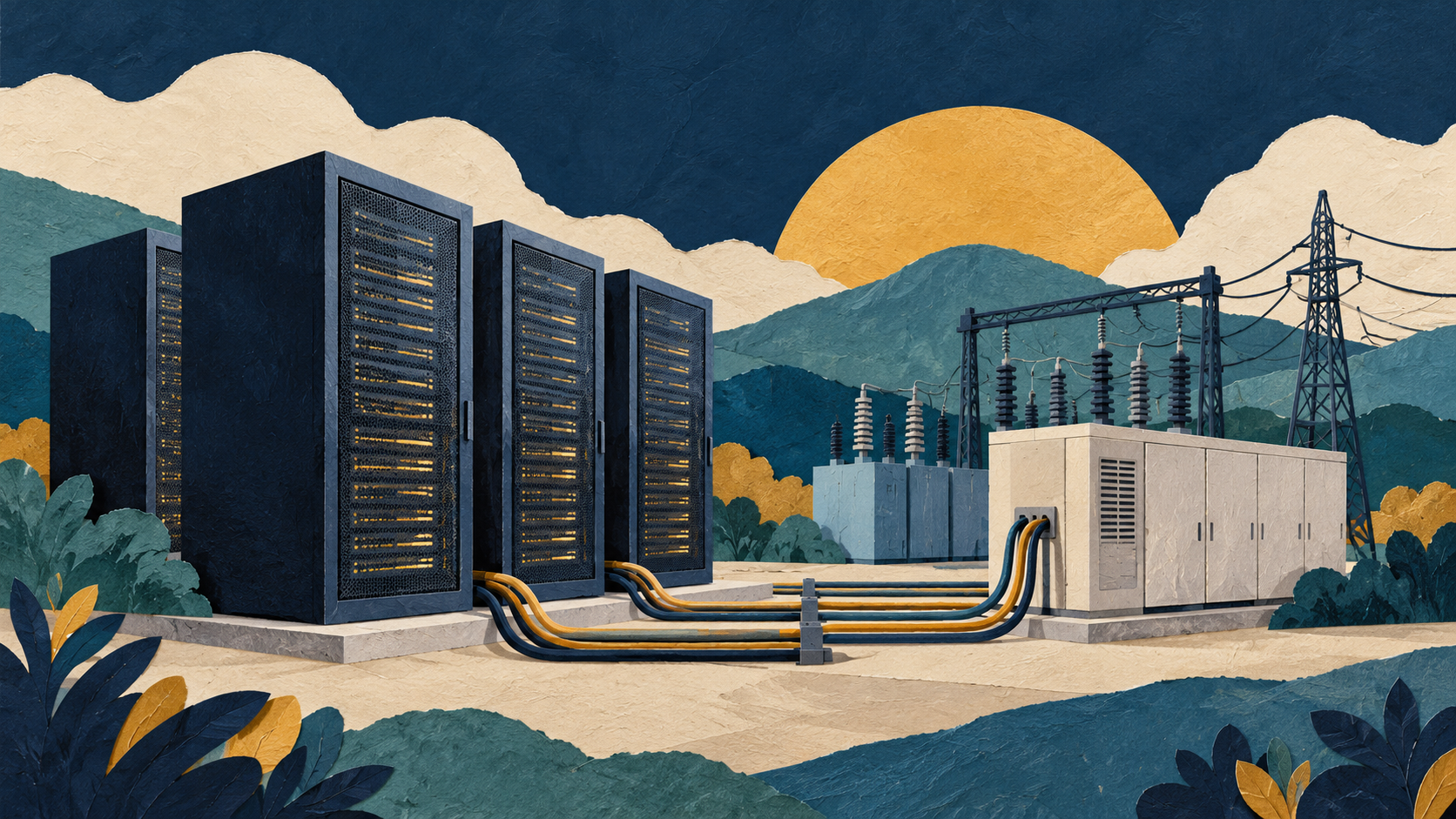
AI-generated illustration: generic server cabinets and an electricity substation symbolize computing and grid coordination; no real facility is depicted.
The fuel mix is a separate question
The IEA’s April 2025 Energy and AI report offers a different lens. Its supply analysis follows the electricity physically reaching data centers, including the local grid mix, rather than simply the energy sources named in corporate purchase contracts. In its Base Case, renewables supply nearly half of the additional global data-center electricity demand through 2030; coal and gas together supply more than 40%. These are results from the 2025 scenario, not revised October 2026 estimates.4
The editorial implication is that an annual procurement claim and the source of electricity at a particular place and time answer different questions. A project can be examined through both lenses without treating either as a complete account. A reduction during one demanding period, by itself, does not establish the fuel mix supplying the remaining hours. This distinction is an interpretation of the IEA’s accounting boundary, not a new emissions estimate.4
Construction schedules do not move together
The same report describes data centers that can enter operation within two or three years, while broader energy infrastructure takes longer to plan and build. Its alternative demand cases vary assumptions about hardware and software efficiency, AI adoption and energy-sector bottlenecks. The resulting problem concerns the timing of investment as well as the final volume of consumption.4
For a proposed campus, that suggests separating the date its buildings are ready from the dates its electricity arrangements can support each stage of operation. An assessment based on one opening date can obscure this sequence. More efficient computing can alter the required equipment, but cannot by itself establish when a particular power project will be completed. These are planning implications of the report’s different development timescales.4
A British proposal shows another policy choice
A UK consultation published on March 12, 2026 explored minimum demand-flexibility requirements for some very large users, including data centers. It also considered voluntary incentives for other projects, such as earlier or cheaper grid access. The proposal distinguished flexibility used only during system stress from arrangements covering winter peaks or broader normal operation.5
Those alternatives describe different bargains. An operator willing to accept rare emergency restrictions has not necessarily accepted routine interruptions. The consultation makes that distinction worth examining, but it does not establish a rule for US or Indian facilities. Nor should a proposal in a March document be read as proof of what was finally implemented.5
Read supply and connection decisions together
Taken together, the IEA research and the British consultation suggest a broader comparison than a single flexibility percentage: what supplies the electricity, when the supporting assets become available, and which operating conditions a connection assumes. Improving one element may help a project without resolving the others. Keeping those questions separate makes it possible to explain both the opportunity and the limits without promising a universal solution.45
Source notes
-
2026-10-08 · Data centers’ ‘flexible’ power usage could save the grid billions. Can they scale? · Reuters. ↩
-
2026-02-24 · Annual and Peak Electricity Use: History and Future Projections · EPRI. Updated. ↩
-
2026-09-16 · Emerald AI, Google and NVIDIA Launch Alliance to Advance Flexible AI Data Centers · NVIDIA. ↩
-
2025-04-10 · Energy and AI · IEA, Paris. CC BY 4.0. Adapted analysis and translations; chapters: Energy supply for AI, Energy demand from AI. This is a work derived by Global Bole News from IEA material and Global Bole News is solely liable and responsible for this derived work. The derived work is not endorsed by the IEA or its Member countries in any manner. ↩ ↩2 ↩3 ↩4 ↩5
-
2026-03-12 · Accelerating electricity network connections for strategic demand (accessible webpage) · Department for Energy Security and Net Zero. © Crown copyright 2026. Adapted under Open Government Licence v3.0. ↩ ↩2 ↩3