Amazon's cloud growth meets cash-flow pressure as its 10-Q confirms AI investment progress
AWS revenue growth has not eliminated the cash demands of upfront investment. Amazon's quarterly filing separates cloud operations, infrastructure capital spending and completed equity investments in OpenAI.
By 全球伯乐 News
Research and compilation
On this page
Amazon's third-quarter results show two trends advancing together: cloud revenue and operating income are growing, while equipment and infrastructure investment continues to consume cash. The company announced its results on October 29; its subsequently disclosed Form 10-Q lists operating results, cash capital expenditure and equity investments in OpenAI separately. All are connected with AI expansion, but they are not interchangeable financial measures.12
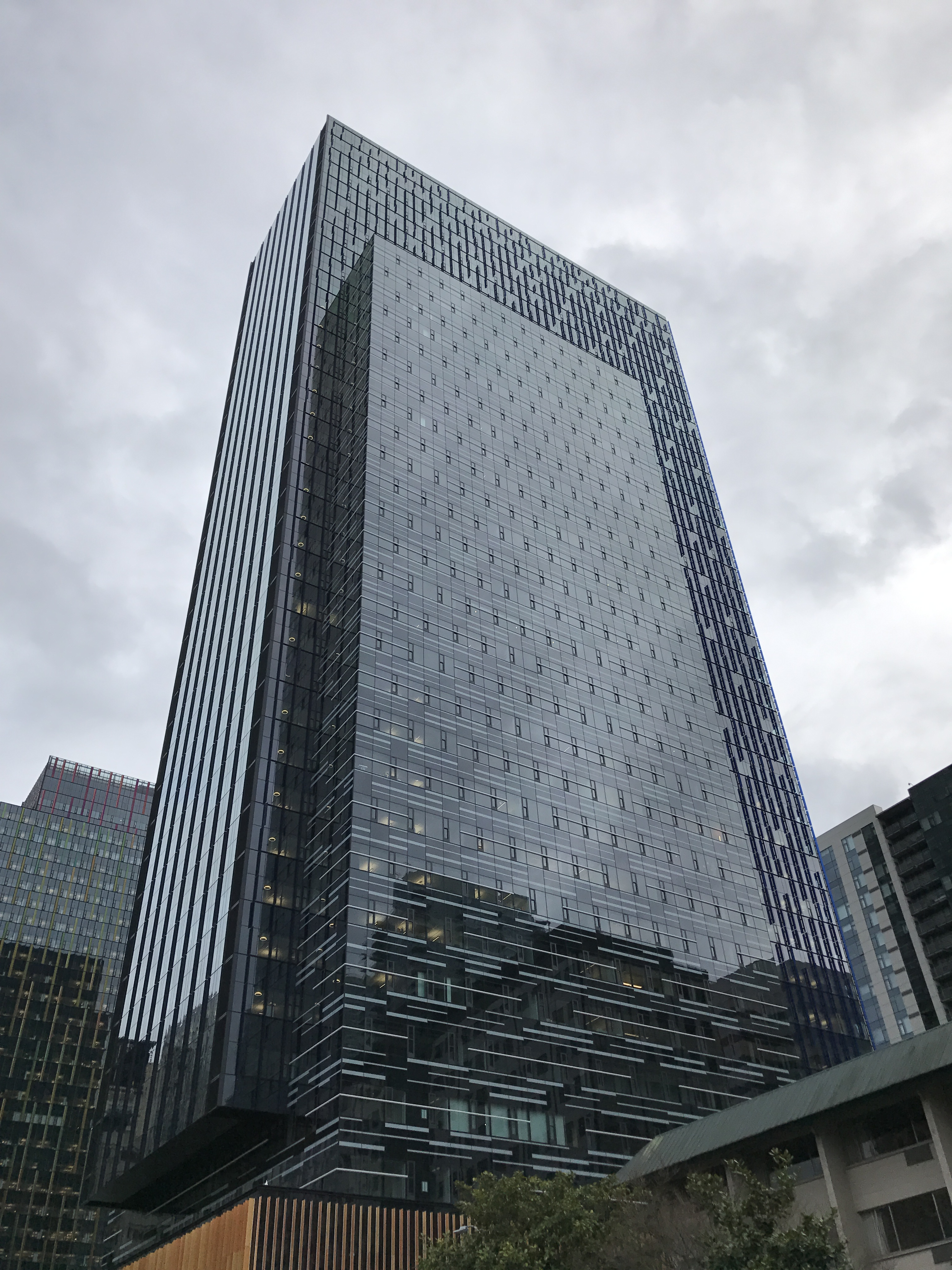
January 18, 2017, Seattle, United States. Photograph by Adamajreynolds, Day 1 Tower Seattle WA Jan 17, CC BY-SA 4.0. Archival photograph, not the setting of this earnings announcement.
Growing cloud revenue does not mean new investment has already paid back
For the third quarter ended September 30, Amazon reported net sales of $201.944 billion, up approximately 12% year on year, and operating income of $28.076 billion. AWS accounted for net sales of $45.984 billion, up approximately 39%, and operating income of $17.773 billion. These figures show cloud demand translating into current-quarter revenue and operating earnings. They do not, on their own, establish that all of the latest AI infrastructure investment has delivered its expected return.1
Revenue arises as services are delivered, whereas equipment spending often precedes the realization of demand. Operating income, capital expenditure and cash recovery are observed over different periods. Treating AWS's growth rate as the investment return on new data centers would therefore confuse business performance with investment efficiency. Assessing the latter still requires subsequent cash flows and facility utilization.
Negative free cash flow requires attention to definitions and periods
For the trailing twelve months ended September 30, net cash provided by operating activities was $168.3 billion, above $130.691 billion in the corresponding prior-year period. Purchases of property and equipment, net of proceeds from sales and associated incentives, nevertheless reached $210.657 billion over the same period. Under the company's definition, which subtracts those net purchases from operating cash flow, free cash flow moved from an inflow of $14.788 billion a year earlier to an outflow of $42.357 billion. This comparison covers twelve months, not the third quarter alone.1
The 10-Q also explains that this non-GAAP measure does not represent all residual cash available for discretionary use: it excludes cash requirements such as principal repayments on debt, investments in private-company equity and business acquisitions. Negative free cash flow therefore does not mean operations generated no cash. Conversely, positive operating cash flow does not establish that operating cash fully funded every investment. The complete cash-flow statement needs to be read alongside this supplementary measure.1
The company identifies technology infrastructure as the main destination of cash capital expenditure, with most of that infrastructure supporting AWS growth; spending also includes fulfillment-network expansion. Cash capital expenditure was $75.9 billion in the third quarter and $172.2 billion in the first nine months. Approximately $220 billion for the full year remains a company expectation, not an amount already spent. Capital expenditure, the net equipment purchases above and free cash flow have different definitions and measurement periods and should not be collapsed into a single figure.1
The OpenAI equity investment has occurred, but it is not capital expenditure
The partnership announcement on February 27 set out a planned Amazon investment of $50 billion, beginning with $15 billion, with the remainder subject to conditions.3 The new 10-Q records that, following the initial first-quarter investment, Amazon invested another $13.7 billion in the second quarter and the remaining $21.3 billion in the third quarter. By September 30, the cumulative $50 billion had been invested in OpenAI's Series C preferred stock.1
That filing provides clear evidence of the transition from an announced commitment to completed investment. Describing the entire $50 billion as an unfulfilled plan would omit the latest progress. Adding the equity investment to Amazon's equipment capital expenditure, or treating it as AWS revenue, would also be incorrect. The 10-Q classifies it as an equity investment in a private company not accounted for under the equity method; subsequent observable price changes or impairment may also affect earnings.1
The continuing question raised by these results is whether growth will produce stable cash recovery after the upfront spending. AWS's quarterly operating performance, company-wide cash outlays and changes in the value of equity holdings need to be assessed separately. Evidence from future quarters about investment efficiency will be more informative than treating expansion plans as returns already achieved.
Source notes
-
2026-10-30 (filing date; reporting period ended 2026-09-30) · Amazon.com, Inc., Form 10-Q, Quarterly Report for the Period Ended September 30, 2026, disclosed through the U.S. Securities and Exchange Commission's EDGAR system. See the financial statements, Note 2, Liquidity and Capital Resources, Non-GAAP Financial Measures and Guidance. Filing record. ↩ ↩2 ↩3 ↩4 ↩5 ↩6 ↩7
-
2026-10-29 · Amazon.com, Inc., Amazon.com Announces Third Quarter Results. ↩
-
2026-02-27 · OpenAI, OpenAI and Amazon announce strategic partnership. ↩