UK pledges another £432 million for rough sleeping: connecting winter help with lasting housing
The additional funding raises the commitment to £874 million, but a route off the streets by Christmas is not a guarantee of permanent housing for everyone. England’s single-night, monthly and returning rough-sleeping figures show why continuing support matters.
Research and synthesis
On this page
The UK government announced an additional £432 million funding commitment to address rough sleeping on October 25, increasing the money behind the prime minister’s pledge from £442 million to £874 million. Further details will follow in the Budget. The government says support will continue beyond March 2027 and for the remainder of this Parliament. Its immediate goal is more urgent: to give every person sleeping rough a route off the streets or other support before Christmas.1

AI-generated editorial illustration: a path toward a brightly lit home, an open door and a key represent stable housing and continuing support.
Two different commitments need to be kept separate: providing help this winter, and enabling people to stay housed over the longer term. The first does not mean delivering permanent homes to everyone by Christmas. Nor does announcing funding mean that all the money has been distributed or that accommodation is already available. The published programme guidance applies to England; its coverage and statistical scale should not be extended to the whole UK.2
Winter relief and lasting accommodation follow connected timelines
The existing Rough Sleeping Programme has two parts. The first provides routes off the streets through accommodation, outreach and support tailored to individual needs, while finding a stable place to live next. The second expands stable housing and continuing support for people with a long history of rough sleeping who need more intensive assistance. The guidance expects the first additional long-term homes to be delivered from 2027/28, while support can begin in winter 2026.2
That distinction explains why the number of beds available on Christmas Day cannot be the only measure. Emergency accommodation can reduce the immediate risks of sleeping rough. But without follow-on housing and services, the problem can return when winter provision ends. Conversely, waiting until every permanent home is ready before offering help would leave immediate needs unmet. The task is to connect the entire process: making contact, assessing needs, offering an interim option, finding suitable housing and helping someone remain there.
Of the original package of approximately £442 million, £255.5 million was for services and ongoing support, £178 million for capital investment in long-term accommodation, and £8.4 million for a community fund. Guidance updated on September 30 says the 2026/27 allocations had already been paid, with payments for subsequent years and the acquisition of long-term housing to follow. Those statements concern the existing package. They do not establish that the additional £432 million announced on October 25 has been disbursed; its detailed allocation still depends on the Budget and subsequent documents.2
A single-night count does not capture all service demand
England’s latest annual statistics estimate that 4,793 people slept rough on one night in autumn 2025, up 3% on the previous year and the fourth consecutive annual increase. Local authorities produce this estimate for a chosen night in October or November. It is not the total number of people who slept rough during the year, nor a count of everyone experiencing homelessness. People in temporary accommodation, staying on someone’s sofa or living in other insecure circumstances cannot simply be added to this particular rough-sleeping measure.3
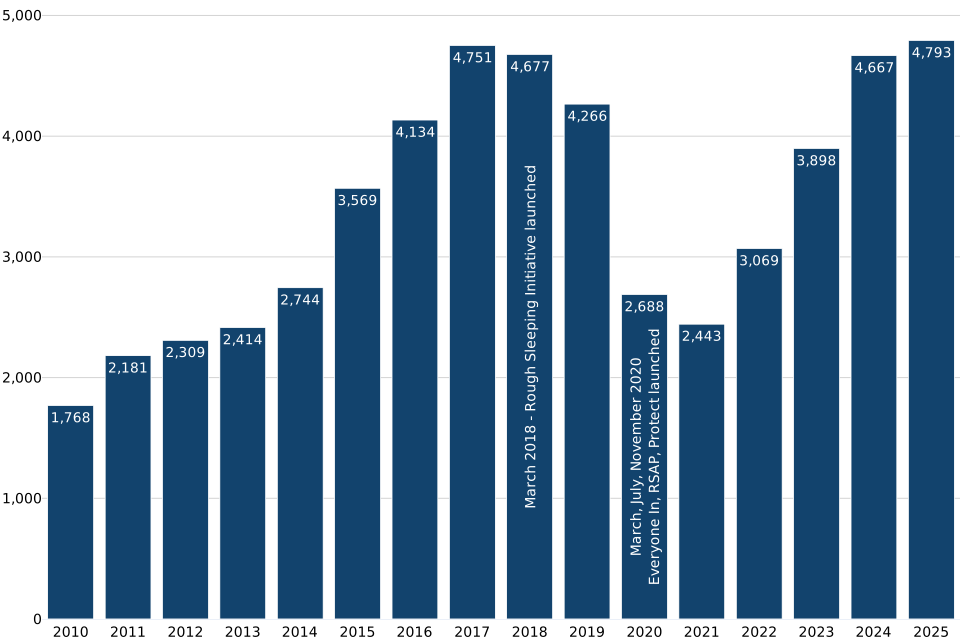
Estimated number of people sleeping rough on a single autumn night in England, 2010–2025. Original chart: Ministry of Housing, Communities and Local Government, published February 26, 2026; © Crown copyright 2026, OGL v3.0.3
More recent monthly information shows another side of the problem. In June 2026, approximately 8,748 people were recorded sleeping rough across the month in England, compared with a single-night estimate of 3,980 that month. A monthly figure more than twice the nightly figure is not a statistical contradiction: some people leave the streets while others begin sleeping rough on different nights. Providing as many beds as the count for one night may therefore fail to cover changing demand throughout the month.4
The pace of change also needs to be distinguished. The June monthly total was only 0.2% higher than in June 2025, while the single-night count rose by about 3%; both measures in London fell year on year. These figures show continuing pressure, but do not justify saying that conditions are deteriorating sharply everywhere at once. Translating national funding into local services requires attention to different needs, housing costs and existing resources, rather than applying an identical plan based on one national total.4
The figures are also affected by seasonality, temporary night shelters and outreach coverage. Official technical guidance notes that conditions and accommodation supply differ between summer and winter. Monthly information also depends on contact by workers and local recording, and is an estimate. Assessing performance therefore requires both comparisons within the same season and attention to whether services are reaching people who were previously harder to identify. A figure from one warm or cold night is not a complete verdict.45
Turning a place to stay into a lasting exit from the streets
The June data identified approximately 3,253 people sleeping rough long term, or 37% of the monthly total. Around 1,208 people were returning to rough sleeping, including 321 who had entered settled accommodation in the preceding 12 months. These figures cannot, on their own, explain why each person returned. They do show why a move into accommodation should not be treated as the end of the problem.4
The guidance calls for continuing, individualised support that links housing with health, social care and other services. It also stresses early intervention when someone faces an imminent risk of rough sleeping: people should not have to demonstrate that they are already sleeping on the streets before receiving help. The programme should not simply replace existing service budgets.2 For delivery teams, the challenge is not just finding homes. It is also maintaining contact, reducing repeated referrals and avoiding breaks in support during the move from temporary to settled accommodation.
Nor does the programme automatically create identical accommodation entitlements for everyone. The official guidance states that existing legal duties and restrictions remain unchanged. Access to housing assistance and public funds may still differ between individuals, and local bodies must assess cases within their respective statutory powers. This qualification coexists with the political goal of finding everyone a route off the streets. Reporting should not turn the aspiration to offer universal help into an already effective, unconditional guarantee of permanent housing.2
The October 25 summit also brought commitments from social organisations and businesses. The National Housing Federation will work with housing associations to identify at least 2,000 potential homes or bedspaces, including vacant properties that could be brought back into use. But identifying potential resources is different from making them ready for occupation. Property condition, accompanying support and local delivery all require further confirmation.1
Similarly, 2,000 should not simply be subtracted from 4,793 or 8,748. The first figure combines homes and bedspaces and describes potential supply. The other two estimate people over different periods. Combining different dates and units into an apparent housing shortfall may look straightforward, but obscures the practical questions: what accommodation someone needs, when they can move in and whether continuing care is required.
The next tests should therefore go beyond the £874 million headline. When funding is specified locally, how many real options become available, how many people accept help and enter suitable accommodation, and how many remain housed after winter are connected measures of delivery. The government guidance already proposes monthly monitoring of committed spending, offers of help and bedspaces, alongside rough-sleeping and long-term rough-sleeping indicators.2 More funding creates scope to expand services. Whether it reduces repeated rough sleeping will depend on subsequent delivery and sustained housing outcomes.
Source notes
-
2026-10-25 · PM confident every rough sleeper will have route off the street by Christmas as funding doubles · UK Prime Minister’s Office; public government information used under OGL v3.0. ↩ ↩2
-
Published 2026-08-19; updated 2026-09-30 · Rough Sleeping Programme Guidance · Ministry of Housing, Communities and Local Government; applies to England; OGL v3.0. ↩ ↩2 ↩3 ↩4 ↩5 ↩6
-
2026-02-26 · Rough sleeping snapshot in England: autumn 2025 · Ministry of Housing, Communities and Local Government; © Crown copyright 2026, OGL v3.0. ↩ ↩2
-
2026-08-27 · Rough sleeping data framework, April to June 2026 - release · Ministry of Housing, Communities and Local Government; reporting period April–June 2026; figures cited in this article refer to June; OGL v3.0. ↩ ↩2 ↩3 ↩4
-
2026-02-26 · Rough sleeping snapshot in England: autumn 2025 - technical report · Ministry of Housing, Communities and Local Government; OGL v3.0. ↩