DOE and Purdue test steel-plate composite SMR construction as NASA and CSA complete final ISS roll-out solar array
The National Reactor Innovation Center and Purdue University will build scaled steel-plate composite containment structures, while astronauts raised International Space Station power capacity to roughly 215 kilowatts.
By 全球伯乐 News
Research and compilation
On this page
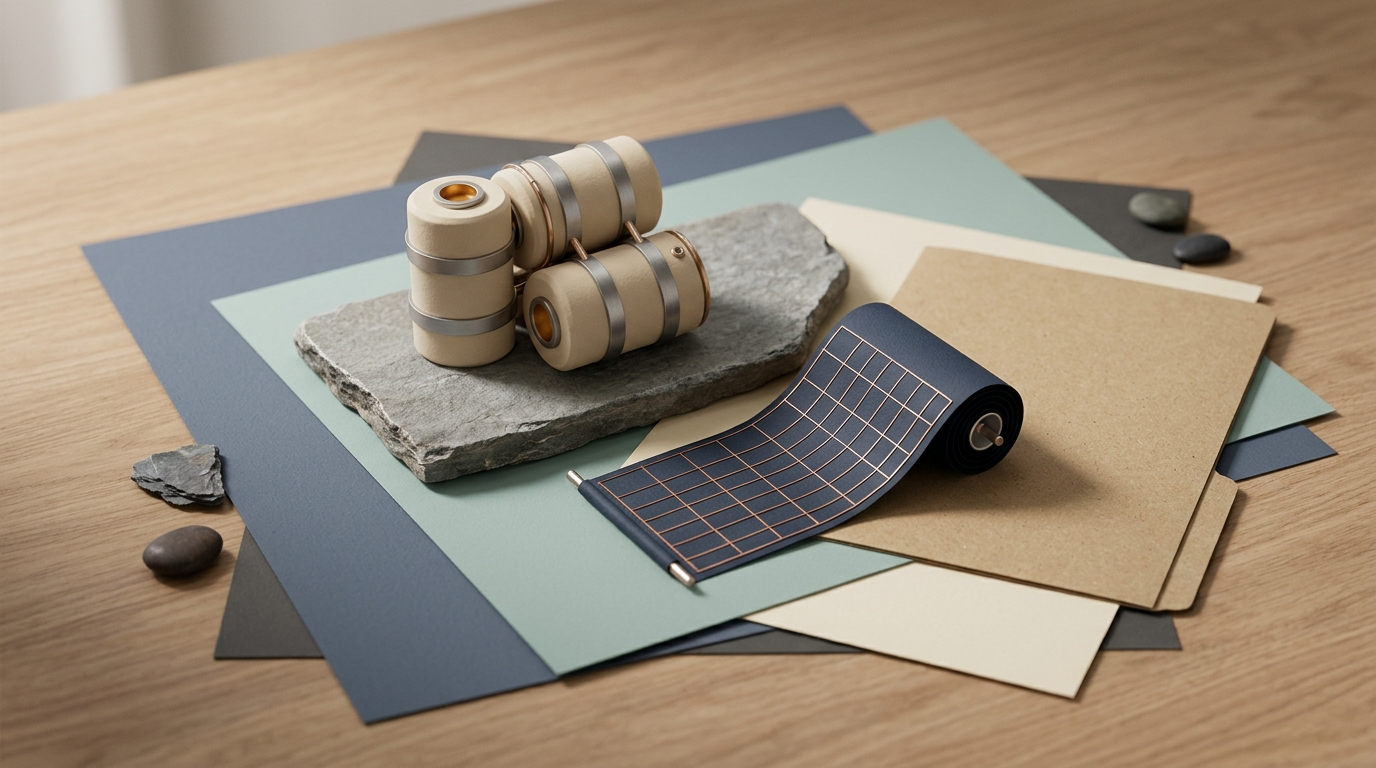
AI-generated editorial illustration: interlocking cylindrical reactor module models on a stone slab, an unrolling solar blanket model and a blank engineering folder represent modular SMR construction research and orbital solar upgrades, not actual hardware.
Steel-plate composite modules and real-time digital twins target small modular reactor construction risk
The US Department of Energy’s National Reactor Innovation Center (NRIC)—headquartered at Idaho National Laboratory (INL)—and the Purdue Applied Research Institute’s Infrastructure Innovation Lab (PIIL) announced a partnership on November 5, 2026, under the Advanced Construction Technology Initiative (ACTI) to design, fabricate, erect, and test a scaled steel-plate composite containment vessel and a surrounding model reactor building for small modular reactors (SMRs). Steel-plate composite construction uses shop-fabricated steel faceplates filled with concrete on-site, eliminating traditional rebar cages and removable formwork while combining steel’s tensile strength and ductility with concrete’s stiffness and thermal control. Structural testing is supported by Purdue’s Bowen Laboratory—which earned ISO 9001 quality management certification in October 2026—with regulatory and technical input from the Nuclear Energy Institute (NEI) and the Electric Power Research Institute (EPRI).12
Alongside physical assembly and concrete placement, Purdue researchers will build a real-time digital twin to track construction tolerances, detect assembly errors early, and model cost performance, while developing workforce training curricula for advanced nuclear construction. Purdue University explicitly notes that both scaled structures erected on campus are temporary, non-nuclear structural demonstrations: no nuclear materials or reactor equipment will be used, and the test assemblies will be disassembled and recycled once structural integrity evaluations conclude. The project generates pre-commercial engineering data rather than authorizing a commercial nuclear power plant.12
A 6-hour, 59-minute spacewalk installs the eighth and final IROSA wing on channel 3B, lifting station power to 215 kilowatts
Also on November 5, 2026, NASA astronaut Anil Menon (on his fifth career spacewalk) and Canadian Space Agency (CSA) astronaut Joshua Kutryk (on his second career spacewalk) completed U.S. Spacewalk 101—the 286th spacewalk in International Space Station assembly and maintenance history—beginning at 8:36 a.m. EST and concluding at 3:35 p.m. EST after 6 hours and 59 minutes. During the excursion, the duo installed and deployed the eighth and final International Space Station Roll-Out Solar Array (IROSA) on the 3B power channel along the station’s starboard truss.3
According to NASA, orbital work to augment the station’s power system began in February 2021 and required 18 spacewalks to prepare power channel hardware and deploy all eight roll-out wings. With the final array unfurled on channel 3B, total International Space Station power generation capacity increases from 160 kilowatts to approximately 215 kilowatts, a gain of more than 34%. The terrestrial SMR civil-engineering testbed and the orbital solar upgrade represent distinct stages of energy engineering: Purdue and NRIC are validating non-nuclear modular construction methods to de-risk future terrestrial reactor builds, whereas NASA and CSA have completed the final hardware installation of a multi-year orbital power augmentation campaign.123
Source notes
-
2026-11-05 · Department of Energy and Purdue partner to improve nuclear reactor construction · Idaho National Laboratory. ↩ ↩2 ↩3
-
2026-11-05 · Purdue Applied Research Institute enters into partnership with U.S. Department of Energy to advance nuclear construction technologies · Purdue University. ↩ ↩2 ↩3
-
2026-11-05 · Spacewalkers Install Final Roll-Out Solar Array · NASA. ↩ ↩2