US DOE renews Puerto Rico grid emergency orders for 400-mile line clearing as IAEA reviews 15 years of nuclear waste characterization
Department of Energy Order No. 202-25-2F takes effect November 8 to address transmission lines operating at up to 70% derating, while the IAEA’s 42-country LABONET network assessed non-destructive testing and scaling factors for legacy radioactive waste.
By 全球伯乐 News
Research and compilation
On this page
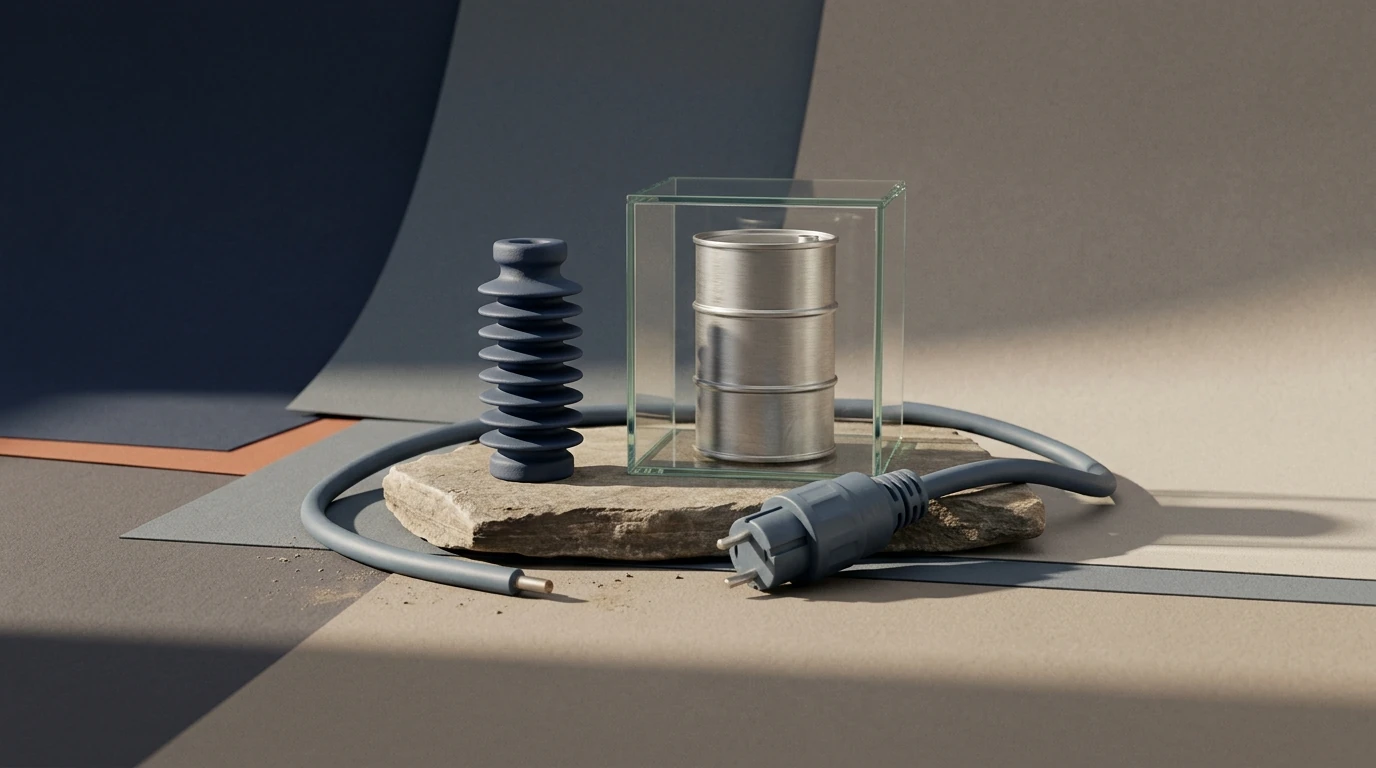
AI-generated editorial illustration: a matte dark-blue ribbed ceramic high-voltage insulator column, a brushed-steel containment drum model inside a clear glass frame and an insulated power cable connector on a flat stone slab represent transmission right-of-way maintenance and radioactive waste characterization, not a real substation or nuclear facility.
Puerto Rico trunk lines operating at up to 70% derating: the 400-mile right-of-way clearing mandate through February 2027
The U.S. Department of Energy (DOE) issued two renewed Federal Power Act Section 202(c) emergency orders—including DOE Order No. 202-25-2F—taking effect on November 8, 2026 through February 5, 2027, authorizing the Puerto Rico Electric Power Authority (PREPA) to dispatch critical generation units and mandating accelerated transmission right-of-way vegetation clearing for the island’s 3.2 million residents.12 Separately, on November 6, 2026, the International Atomic Energy Agency (IAEA) Department of Nuclear Energy published findings from the 15th anniversary technical meeting of the International Network of Laboratories for Nuclear Waste Characterization (LABONET), bringing together 74 specialists from 42 countries to evaluate measurement validation and inventory methods for legacy and decommissioning waste.3
According to the text of DOE Order No. 202-25-2F, overgrown vegetation along transmission corridors has forced portions of Puerto Rico’s trunk grid to operate with up to 70% derating to prevent heated lines from sagging into trees and triggering faults or wildfires.2 Engineering estimates cited in the order indicate that full vegetation clearing across the 115 kV and 230 kV transmission rights-of-way could reduce adverse outage events by over 80%.2 The order directs PREPA and its agents to clear at least an additional 400 miles of designated lines by February 5, 2027 and submit biweekly Wednesday compliance reports using the July 8, 2025 DOE reporting templates; however, the order notes that prior vegetation-management delays have already postponed necessary repairs to degraded transmission and distribution hardware needed to stabilize voltage and frequency regulation.2
Fifteen years of IAEA LABONET: scaling factors, non-destructive assay and disposal acceptance limits for legacy nuclear waste
In the nuclear back-end sector, the IAEA report details outcomes from the Technical Meeting on Advanced Techniques for Radioactive Waste Characterization held in Szeged, Hungary (hosted by ELI-ALPS and ISOTOPTECH, alongside a site visit to Hungary’s Bátaapáti National Radioactive Waste Repository), focusing on how physical, chemical and radiological measurements determine whether waste packages meet repository acceptance limits.3 For older legacy waste with incomplete historical records or uneven radionuclide distribution, specialists examined gamma scanning, 3D tomography, X-ray diffraction for crystalline phases and laser-based imaging to identify internal porosity and structural defects inside sealed waste drums.3
To quantify radionuclides that are difficult to measure directly from outside a container, participants evaluated the use of “scaling factors”—established ratios between easily measured gamma emitters and hard-to-measure isotopes—alongside operational case studies from Ukraine’s Rivne Nuclear Power Plant, Lithuania’s Maisiagala historical storage retrieval, and digital inventory systems in Canada and Brazil.3 LABONET Chairman Leonardus van Velzen emphasized that scaling factors require representative sampling and periodic recalibration whenever reactor operating conditions or waste streams shift, ahead of the IAEA’s International Conference on Advancement in Radioactive Waste Management scheduled for October 11–15, 2027 in Vienna.3
Source notes
-
2026-11-06 · Energy Secretary Builds on Progress to Strengthen Puerto Rico's Energy Reliability · U.S. Department of Energy (DOE). ↩
-
2026-11-06 · Department of Energy Order No. 202-25-2F (Puerto Rico Electric Power Authority) · U.S. Department of Energy (DOE). ↩ ↩2 ↩3 ↩4
-
2026-11-06 · International Cooperation Strengthens Radioactive Waste Characterization · International Atomic Energy Agency (IAEA). ↩ ↩2 ↩3 ↩4 ↩5