Quantinuum and RIKEN Upgrade Reimei Quantum Computer to H2 System and Partner With SoftBank on Quantum-AI Data Centers
Quantinuum and Japan's RIKEN announced on November 10 the completion of the System Model H2 upgrade to the Reimei trapped-ion quantum computer, pairing Reimei with the Fugaku and ROQUO supercomputers for materials and biomolecular AI simulations while partnering with SoftBank Corp. to link quantum computers directly to commercial AI data centers.
By 全球伯乐 News
Research and compilation
On this page
Reimei Upgraded to System Model H2: Pairing With Fugaku and ROQUO for Magnetism and Biomolecular AI Simulations
Full-stack quantum computing company Quantinuum (NASDAQ: QNT) and RIKEN, Japan’s leading national comprehensive research institute, announced in Tokyo on November 10, 2026, that the Reimei trapped-ion quantum computer installed at the RIKEN Center for Computational Science (R-CCS) has completed its hardware upgrade to System Model H2.1 Operated under the JHPC-quantum hybrid platform project funded by Japan’s New Energy and Industrial Technology Development Organization (NEDO, Project JPNP20017) and led by RIKEN division director Dr. Mitsuhisa Sato, the H2 upgrade substantially expands the complexity of quantum systems that researchers can investigate alongside high-performance classical supercomputing.1
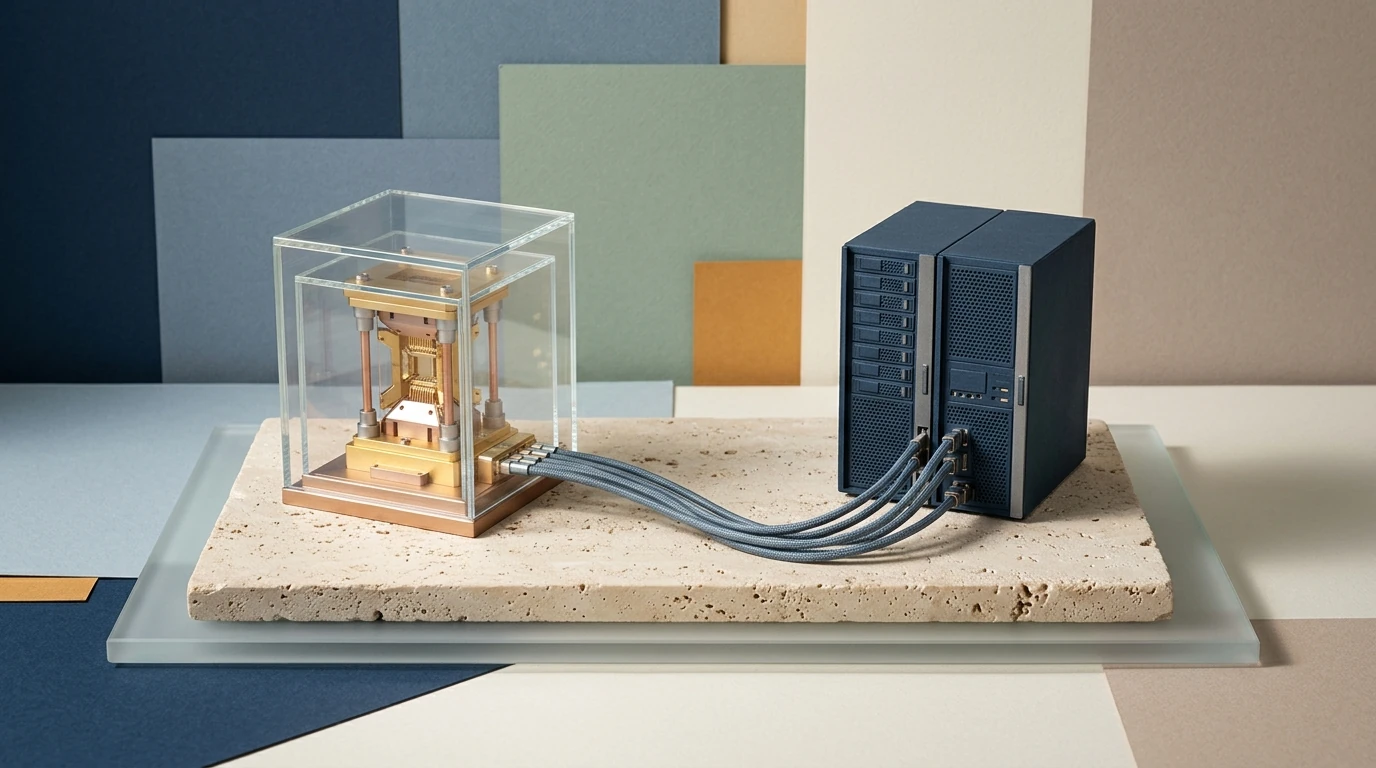
AI-generated editorial illustration: a gold miniature trapped-ion resonator inside a double-walled glass cube connected via braided fiber cables to a matte dark-blue supercomputer module on porous stone represents quantum-AI hybrid supercomputing integration, not a real server room.
Two early 'Quantum-AI' demonstration projects have already begun operating on the upgraded Reimei platform ahead of public service launch.1 In materials simulation, researchers are using RIKEN’s JHPC-quantum GPU supercomputer ROQUO to train an artificial intelligence model on Reimei-generated quantum data for atomic-level magnetism simulations; preliminary experimental findings suggest the hybrid model produces more accurate predictions than AI models trained solely on classical simulations and greater precision than standalone quantum execution, informing materials discovery for ultra-high-field MRI and smart power grids.1 In biomolecular simulation, the partners are combining Reimei, RIKEN’s flagship Fugaku supercomputer, and an NVIDIA evolutionary AI agent running on ROQUO to simulate a complex photoactive biomolecule for higher-efficiency solar cells—work that aligns with a planned $1 billion US-Japan AI discovery partnership under the U.S. Genesis Mission.1
Building a Made with Japan Fault-Tolerant Quantum Computer and SoftBank Quantum-AI Data Center Link
Building on the Reimei H2 upgrade, Quantinuum and RIKEN signed a new Memorandum of Understanding to co-develop a fault-tolerant 'Made with Japan' quantum computer involving Japanese universities and domestic precision component suppliers, combining Quantinuum’s QCCD trapped-ion architecture with Japanese manufacturing expertise.1 While Quantinuum CEO Dr. Rajeeb Hazra emphasized the long-term goal of domestic fault-tolerant capability, the disclosure explicitly notes that current simulation findings remain preliminary experimental results and that scaling qubit counts and error-correction frameworks to commercial logical computation remains subject to multi-year engineering execution.1
Under a separate agreement announced on November 10, Quantinuum, RIKEN, and SoftBank Corp. (TOKYO: 9434) will jointly evaluate infrastructure readiness to connect quantum computers directly with commercial AI data centers across Japan.1 Takenori Kobayashi, Vice President and Head of Product Research and Development at SoftBank Corp., stated that the collaboration seeks to advance a 'Quantum AI Datacenter' architecture capable of delivering commercial hybrid computing services to enterprise users beyond academia.1 This push to integrate specialized accelerators with AI data centers parallels broader international policy tracking released by the OECD on November 10, which scheduled forthcoming analytical reports on G7 competition over AI compute inputs and global 2.5D/3D semiconductor packaging capabilities.12
Source notes
-
2026-11-10 · Quantinuum and RIKEN Expand Partnership to Accelerate the Commercialization of Quantum-AI Hybrid Supercomputing in Japan · Quantinuum and RIKEN (EQS Corporate News). ↩ ↩2 ↩3 ↩4 ↩5 ↩6 ↩7 ↩8 ↩9 ↩10
-
2026-11-10 · Forthcoming titles · Organisation for Economic Co-operation and Development (OECD). ↩