India plans charging and battery-swapping facilities on rural public land, with specific sites still to come
India's Ministry of Panchayati Raj and CESL have signed a charging and battery-swapping memorandum targeting suitable local public land. Station numbers, budgets and opening dates have not been announced.
By 全球伯乐 News
Research and compilation
On this page
A signed partnership does not mean facilities are already built
India's Ministry of Panchayati Raj said in an October 31 release that it had signed a memorandum of understanding with Convergence Energy Services Limited (CESL) during a national workshop held the previous day. The plan is to establish electric-vehicle charging and battery-swapping stations on suitable land belonging to Panchayat local-government bodies. CESL is a wholly owned subsidiary of Energy Efficiency Services Limited (EESL), under India's Ministry of Power.1
Locations under consideration include local-government premises and suitable sites along state and national highways, potentially serving two-, three- and four-wheelers as well as medium- and heavy-duty vehicles. The partnership's scope is therefore not confined to urban passenger-car charging. But covering a vehicle category does not mean every candidate site will contain the full range of equipment. What has been disclosed so far is the partnership's direction and division of responsibilities, not a list of completed stations.1
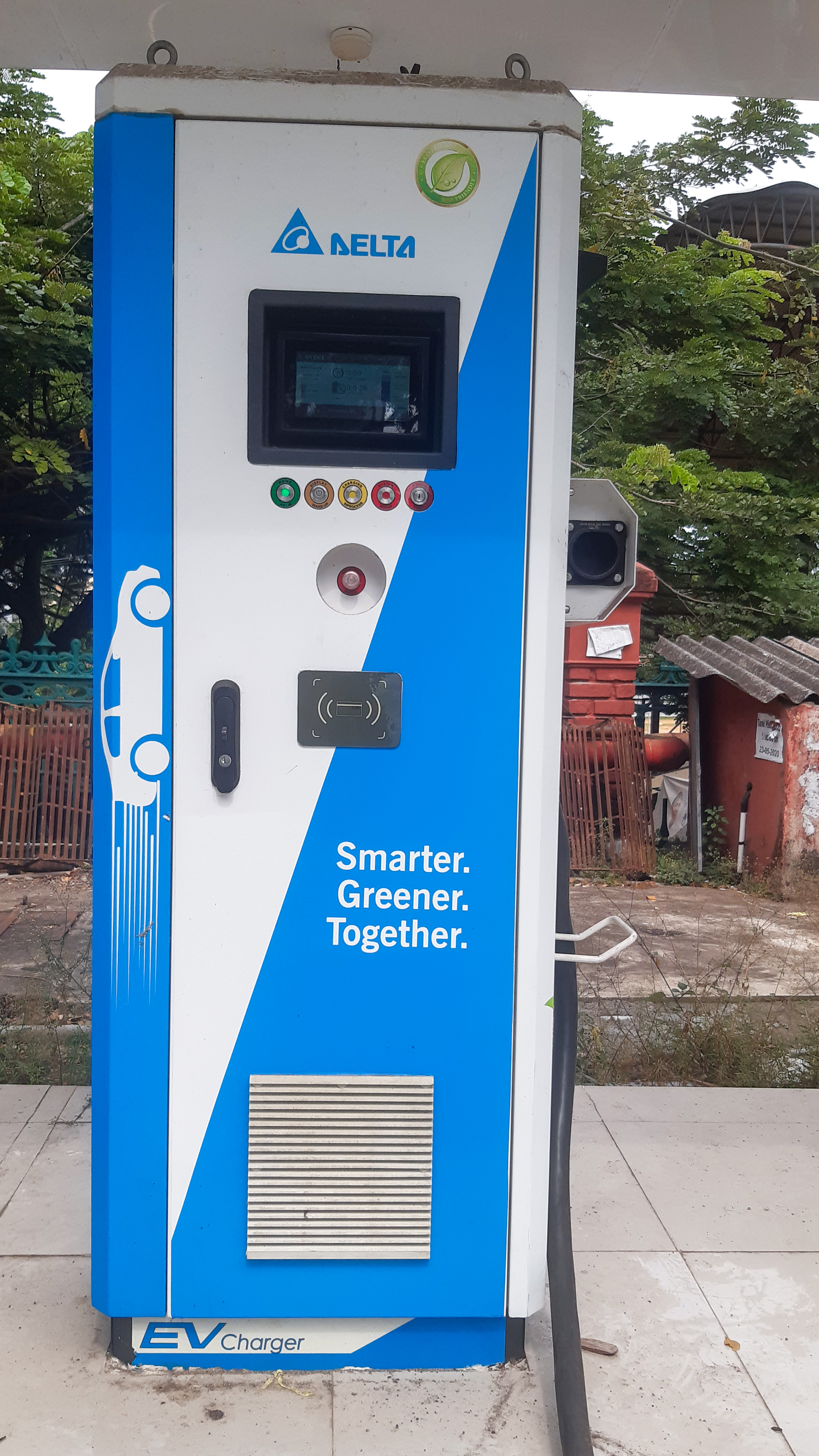
Archival photograph: charging equipment at the Government Secretariat in Thiruvananthapuram, India, August 26, 2020. Photograph by Shagil Kannur; Electric Vehicle Charging Station at Government Secretariat, Thiruvananthapuram.jpg, used under CC BY-SA 4.0. This equipment is not a new site under the memorandum.
Several steps remain between identifying a site and operating it
The release assigns the Ministry of Panchayati Raj responsibility for coordinating with the relevant state departments to identify and monitor suitable sites. CESL will handle site assessment, demand aggregation, supply, installation, testing, commissioning, operation and maintenance. This division connects land coordination with infrastructure delivery, but also makes clear that signing is only the start of the implementation process.1
A charging network requires more than available land. Whether a site can serve vehicles also depends on grid access, compatibility between equipment and vehicle types, demand and reliable operations and maintenance. Battery swapping additionally involves battery specifications and operating models. These are conditions to check when assessing whether a project can become a continuing service, not matters the announcement has already resolved one by one.
The release gives no overall funding amount, confirmed station count, tariff schedule or opening date for the first sites. It is therefore not yet possible to calculate how much charging capacity the partnership will add nationwide, nor to equate its intended scope with service coverage already achieved. More useful evidence of actual progress will come from assessed sites, procurement or operating contracts, and subsequent commissioning records.
Local revenue is an objective; delivery depends on use and upkeep
The government identifies greater own-source revenue for local bodies as a partnership objective. It hopes public land can provide EV services while generating recurring income for public services and community development. The release also links the arrangement to the policy direction of improving local revenue management. This describes an intended mechanism, not revenue already earned or a return already established.1
Other CESL projects have sought charging or swapping operators, but those projects are not this partnership's announced implementation list.2 Tender figures from other locations cannot be transferred into the new memorandum to fill the gap in station numbers. Nor do they establish that every station in this partnership has already adopted a particular investment or contractual model.
The partnership places rural and highway-side charging needs, local public assets and professional operating capacity within one implementation framework. Its value will be tested through subsequent site selection, funding, contracts and usage. Only when equipment can operate reliably, meet actual demand and support the necessary operating and maintenance arrangements can a public asset's planned use become a continuing service and source of income.
Source notes
-
2026-10-31 11:33 (India time) · Union Minister Shri Rajiv Ranjan Singh Urges Concerted Efforts to Build ‘Atmanirbhar Panchayats’ at National Workshop on People’s Plan Campaign, in New Delhi · Ministry of Panchayati Raj / Press Information Bureau, India; workshop held on 2026-10-30. Government release material used under the PIB copyright policy. ↩ ↩2 ↩3 ↩4
-
No single publication date given; accessed 2026-11-01 · Tenders · CESL. Used only to check procurement approaches in other projects, not as evidence that work under this partnership has begun. ↩