US strategic oil reserve: a 282.7-million-barrel snapshot is not the same as immediately available supply
DOE’s October 16 inventory image and same-date site table differ by 0.5 million barrels. Exchanges, future repayments, crude quality and delivery infrastructure must be distinguished from oil already in storage.
By Global Bole News
Research and compilation
On this page
The U.S. Department of Energy’s original Strategic Petroleum Reserve inventory image lists 282.7 million barrels as of October 16: 96.5 million barrels of sweet crude and 186.2 million barrels of sour crude.1 That is a dated physical-inventory snapshot, not the quantity of oil that can reach refiners or consumers immediately.
There is an unresolved discrepancy within the official material. DOE’s separate Quick Facts site table, also dated October 16, totals 282.2 million barrels, comprising 96.6 million sweet and 185.6 million sour. The totals differ by 0.5 million barrels. The opened pages do not explain the difference; neither averaging them nor treating them as reconciled would be justified.2

Archive photograph published September 3, 2014: three white DOE crude-oil tanks at the Sunoco terminal near Nederland, Texas. Source and author: ENERGY.GOV / U.S. Department of Energy, “United States Strategic Petroleum Reserve 012”, original publication. U.S. federal-government work, public domain.
Official series can refer to different observation periods
The EIA’s weekly series, released October 15, runs through the week ending October 9 and records 282.983 million barrels, shown in its table as 282,983 thousand barrels. Its next release is scheduled for October 21.3 That earlier observation cannot resolve the disagreement between two October 16 DOE figures. Publication date, stock observation date and unit must all be kept visible.
The original DOE image also contains a monthly oil-movement table. Its footnote says current inventory captures movements, while monthly totals are captured after inventory is closed for each month.1 An October entry in a mid-October image is therefore not a completed October monthly result. Treating a partial-month entry as a final month would introduce a second timing error.
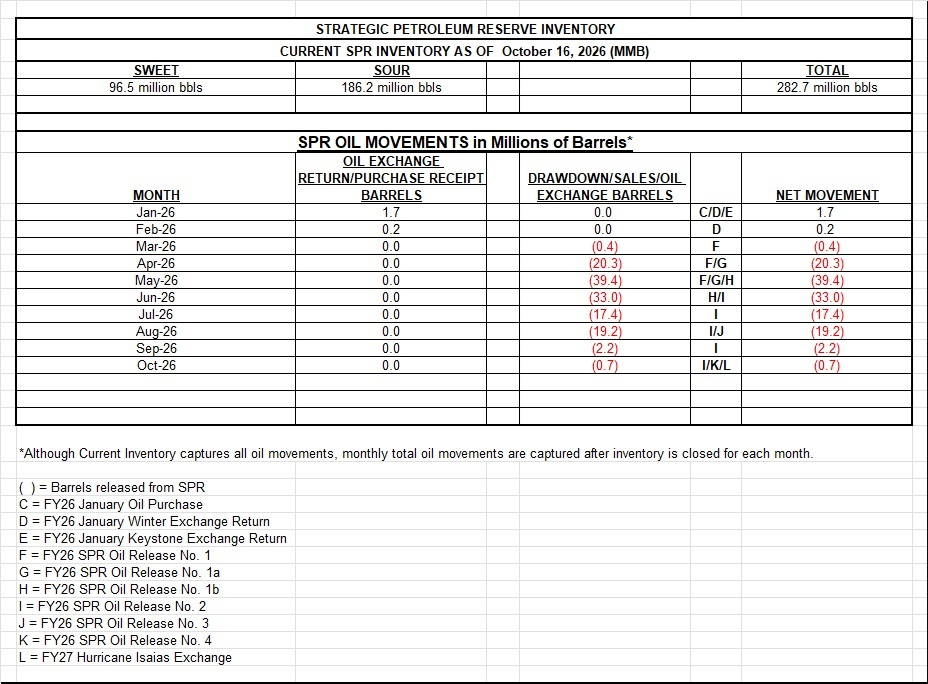
Original DOE inventory table, data dated October 16, 2026. Original producer and source: U.S. Department of Energy, inventory image. Government information is public domain under DOE’s reuse policy.
The useful conclusion is consequently bounded: the reserve was around 283 million barrels on the inventory image’s reporting basis, while a same-date official alternative was lower. The available evidence supports identifying that uncertainty, not attributing it to a particular accounting adjustment, delivery or error without documentation.
An exchange transfers oil now against a future obligation
On September 29, DOE announced a request for proposals for an exchange of up to 40 million barrels from Big Hill and Bryan Mound. That notice scheduled deliveries under awarded exchanges for November and December 2026 and said participating companies would return borrowed oil plus premium barrels.4 A solicitation and its planned delivery window are not proof that the entire offered volume has been awarded or delivered.
DOE’s general explanation distinguishes an exchange from a sale. Exchange arrangements require repayment of oil of similar quality plus an additional volume, with the premium and return date determined by contract.5 The reserve can therefore be scheduled to receive more barrels in the future while physically holding fewer during the interval. Those statements describe different dates and are not contradictory.
The key analytical distinction is between a present asset and a future claim. A promise to return oil cannot simultaneously be counted as oil already in the cavern. Nor does the eventual additional volume remove the operational question of what is available before repayment. Assessing an exchange requires its actual outgoing deliveries, repayment schedule and completed returns, rather than only the gross volume announced.
This also limits what can be concluded about fiscal benefits. More barrels promised back is not, by itself, a complete calculation of the arrangement’s economic value. Timing, quality, transport obligations and performance of the contract matter. The announcement provides the mechanism; it does not supply all the information needed for an independent valuation of every contract.
Storage volume is a stock; delivery is a flow
DOE describes an SPR system of underground salt caverns at four Gulf Coast sites, linked through distribution systems to pipelines, terminals and refineries.6 A stored barrel only becomes usable commercial supply after the relevant release and transportation arrangements, and crude oil still has to pass through refining before it becomes a finished fuel.
This makes infrastructure central to the interpretation of the total. A national stock figure does not identify which refinery can receive which grade on which day. A disruption to a route, a receiving facility or refining operations can constrain the value of a release even when oil remains underground. These are mechanisms, not claims that a particular route is currently unavailable.
Likewise, nominal maximum drawdown capability is not the same as a verified delivery rate for a specific operation. Contract scheduling, receiving capacity and operating conditions have to align. The reserve can provide an emergency buffer without being an unlimited substitute for the rest of the supply chain.
Crude quality affects which barrels can substitute for others
DOE distinguishes sweet and sour crude by sulfur content. Its FAQ describes sweet crude as no more than 0.5% sulfur by weight and the SPR’s sour category as above 0.5% but below 2.0%; it also explains that not every refinery can process sour crude in the same way.5 The inventory’s grade split is therefore economically relevant, not merely a labeling convention.
For the same reason, the requirement to return similar-quality oil matters. A numerical addition to total barrels does not establish that every operational need has been met. Grade, location and refinery compatibility must be considered together. The October image’s 96.5 million and 186.2 million figures should be read as its own grade totals, not silently combined with the alternative figures on the Quick Facts page.
Capacity and import protection answer other questions
DOE lists current authorized storage capacity at 714 million barrels.2 Using the image’s 282.7 million figure gives a simple ratio of about 39.6%. That is a comparison with authorized capacity, not a measurement of immediately usable cavern capacity, nationwide fuel sufficiency or a prediction of shortages.
The Quick Facts page’s approximately 125 days of import protection is explicitly based on December 31, 2025 inventory of 411 million barrels. It is not an October 2026 estimate. DOE also notes that import-protection days change with inventory and net imports, and distinguishes public and private stocks in discussing the international requirement.2 Import coverage is not the same denominator as total domestic petroleum consumption.
The evidence to watch is therefore specific: reconciliation of the same-date inventory figures, actual exchange deliveries, later repayments, grade composition and the operational path from storage to refineries. Future replenishment can strengthen a reserve over time. It does not erase the interval in which a commitment remains a commitment rather than physically available oil, nor does any single inventory total settle the likely direction of fuel prices.
Source notes
-
U.S. Department of Energy, “Strategic Petroleum Reserve Inventory”, original table image, data as of October 16, 2026; no separate publication timestamp displayed. Accessed October 20, 2026. Government-authored inventory material. ↩ ↩2
-
U.S. Department of Energy, “SPR Quick Facts”, site inventory table dated October 16, 2026; accessed October 20. The 282.2-million total is inconsistent with the original inventory image. The import-protection example belongs to December 31, 2025. ↩ ↩2 ↩3
-
U.S. Energy Information Administration, released October 15, 2026, “Weekly U.S. Ending Stocks of Crude Oil in SPR”, latest observed week October 9; unit: thousand barrels. Government statistical series. ↩
-
U.S. Department of Energy, September 29, 2026, “The United States Energy Department Continues Execution of Strategic Reserve Release Commitments”. Official solicitation announcement, not verification of subsequent awards or deliveries. ↩
-
U.S. Department of Energy, “SPR FAQs”, undated living page accessed October 20, 2026. Used for exchange mechanics and crude specifications; historical examples and generic drawdown durations are not treated as present operating measurements. ↩ ↩2
-
U.S. Department of Energy, “Strategic Petroleum Reserve”, undated overview accessed October 20, 2026; its detailed distribution-network snapshot is labeled March 2025. Government-authored background; DOE public-domain policy. ↩